



Union Budget 2026: Key Highlights and Major Announcements by FM Nirmala Sitharaman
 02-Feb-2026
 2 mins read
Trending Now
-

Turtlemint Fintech Solutions IPO GMP, Open Date, Price Band, Issue Size 18-Jun-2026
-
.jpg)
SpaceX IPO: Elon Musk Becomes World's First Trillionaire — Key Facts Explained 13-Jun-2026
-

Zepto IPO, Open Date, Issue Size, Price Band and UDRHP Filed 12-Jun-2026
-
Shah Metacorp Rights Issue May 2026 Details, Record Date, Issue Price 26-May-2026
-

Jio Is Going Public. Here's What That Actually Means for You 11-May-2026
-

Parle Products IPO: India’s Most Iconic Biscuit Brand Going Public? 30-Apr-2026
-
Gujarat Cotex Rights Issue 2026 Details, Record Date, Issue Price 27-Mar-2026
-
.jpg)
Avi Polymers Rights Issue 2026 Details, Record Date, Issue Price 11-Feb-2026
-

D & H India Rights Issue 2026 Details, Record Date, Issue Price 05-Feb-2026
-

Avasara Finance Rights Issue 2025 Details, Record Date, Issue Price 29-Dec-2025

Union Budget 2026 represents a balanced approach combining fiscal prudence with growth-oriented policies.
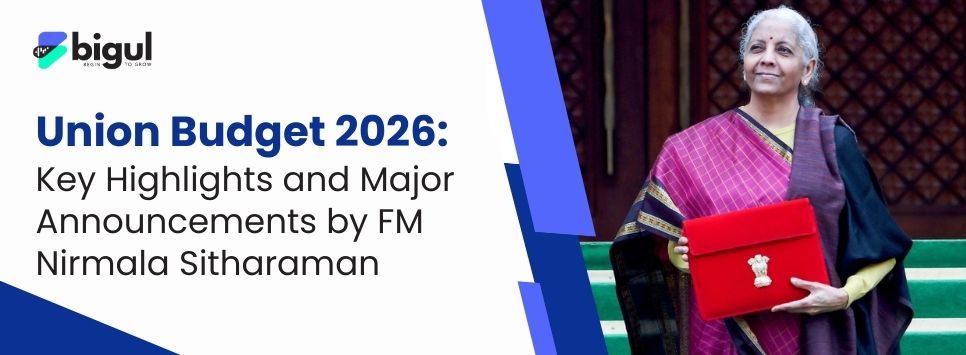
Finance Minister Nirmala Sitharaman presented the Union Budget 2026 on February 1, 2026, marking a historic milestone as the first budget presented on a Sunday in independent India. This comprehensive financial blueprint for FY 2026-27 focuses on three core kartavyas (duties): accelerating economic growth, fulfilling citizen aspirations, and ensuring inclusive development, in line with the vision of Sabka Sath, Sabka Vikas.
Fiscal Discipline and Economic Outlook
The Budget 2026 fiscal deficit is estimated at 4.3% of GDP for FY 2026-27, down from 4.4% in the revised estimates for FY 2025-26. This demonstrates the government's commitment to fiscal consolidation while maintaining growth momentum. Capital expenditure has been increased to Rs 12.2 lakh crore, a significant boost to infrastructure development.
The government projects maintaining India's impressive 7% GDP growth rate, continuing the economic trajectory achieved over the past decade through structural reforms and fiscal prudence.
Income Tax Reforms: Major Relief for Taxpayers
One of the most significant announcements in Budget 2026 income tax changes is the introduction of the new Income Tax Act, 2025, which will come into effect from April 1, 2026. This comprehensive overhaul aims to simplify compliance and reduce taxpayer burden.
Key Tax Highlights:
- Extended Filing Deadlines: Taxpayers can now file revised returns until March 31, extended from the earlier December 31 deadline, with a nominal fee.
- Staggered Return Filing: Individuals with ITR-1 and ITR-2 will continue filing by July 31, while non-audit business cases and trusts get an extended time until August 31.
- TCS Rate Reductions: The Tax Collected at Source (TCS) rate for overseas education and medical treatment has been reduced from 5% to 2%. Similarly, TCS on overseas tour packages has been reduced to a flat 2%.
- NRI Tax Simplification: TDS on property sales by NRIs will now be deducted using the buyer's PAN, eliminating the need for a separate TAN and significantly simplifying the process.
- STT Increased: Securities Transaction Tax on futures has been increased from 0.02% to 0.05%, while STT on options has been raised to 0.15%.
Manufacturing and Industrial Growth
The Budget 2026 highlights placing strong emphasis on scaling up manufacturing across seven strategic sectors:
1. Biopharma SHAKTI Initiative
An allocation of Rs 10,000 crore over five years has been proposed to develop India as a global biopharma manufacturing hub, including establishing new pharmaceutical education institutes and clinical trial sites.
2. Semiconductor Mission 2.0
Building on the success of ISM 1.0, the government will launch ISM 2.0 to strengthen India's semiconductor ecosystem through domestic IP development and supply chain fortification.
3. Electronics Components Manufacturing
The scheme outlay has been increased from Rs 22,919 crore to Rs 40,000 crore following overwhelming investment commitments.
MSME Support
A dedicated Rs 10,000 crore SME Growth Fund has been announced to create future "Champion MSMEs." Additionally, Rs 2,000 crore will be added to the Self-Reliant India Fund for micro enterprises.
Infrastructure and Connectivity
A new dedicated freight corridor from Dankuni in the East to Surat in the West will be established to promote environmentally sustainable cargo movement. The government plans to operationalise 20 new National Waterways over the next five years, starting with waterways in Odisha connecting mineral-rich areas.
Seven High-Speed Rail corridors are proposed, including Mumbai-Pune, Pune-Hyderabad, Hyderabad-Bengaluru, and Delhi-Varanasi routes.
Agriculture and Farmer Welfare
The Budget 2026 agriculture sector receives significant attention with several farmer-centric schemes:
- Coconut Promotion Scheme to benefit three crore people, including one crore farmers
- Dedicated programs for Indian cashew and cocoa to achieve global brand status by 2030
- Support for high-value crops, including sandalwood, walnuts, and almonds
- Launch of Bharat-VISTAAR, an AI-powered multilingual tool for customised agricultural advisory
Employment and Skill Development
The budget emphasises services sector growth through the establishment of a High-Powered 'Education to Employment and Enterprise' Standing Committee. Major initiatives include:
- Training 100,000 Allied Health Professionals over five years
- Khelo India Mission to transform the sports sector
- AVGC Content Creator Labs in 15,000 schools and 500 colleges
- Upskilling 10,000 tourist guides at 20 iconic sites
Social Welfare Initiatives
· Women Empowerment: SHE-Marts will be established as community-owned retail outlets to help women transition from credit-led livelihoods to enterprise ownership.
· Mental Health: NIMHANS-2 will be set up, and mental health institutes in Ranchi and Tezpur will be upgraded.
· Divyangjan Support: Enhanced programs for skill development and access to assistive devices through modernised Assistive Technology Marts.
Regional Development Focus
The budget prioritises Purvodaya states and the North-Eastern Region with:
- Development of an integrated East Coast Industrial Corridor
- Buddhist circuit development in the Northeast states
- 4,000 e-buses for sustainable urban transport
- Five tourism destinations across the Purvodaya states
Conclusion
Union Budget 2026 represents a balanced approach combining fiscal prudence with growth-oriented policies. From comprehensive tax reforms to ambitious infrastructure projects and social welfare initiatives, the budget aims to position India on the path to becoming a developed nation by 2047. With increased capital expenditure, MSME support, and sectoral reforms, the government continues its commitment to sustainable and inclusive economic development.
The emphasis on manufacturing, technology adoption, and skill development, coupled with taxpayer-friendly reforms, makes this budget a significant step toward realising the vision of Viksit Bharat.