



Mainboard IPO vs SME IPO: What's the Difference?
 16-Sep-2026
 2 mins read
Trending Now
-

Turtlemint Fintech Solutions IPO GMP, Open Date, Price Band, Issue Size 18-Jun-2026
-
.jpg)
SpaceX IPO: Elon Musk Becomes World's First Trillionaire — Key Facts Explained 13-Jun-2026
-

Zepto IPO, Open Date, Issue Size, Price Band and UDRHP Filed 12-Jun-2026
-
Shah Metacorp Rights Issue May 2026 Details, Record Date, Issue Price 26-May-2026
-

Jio Is Going Public. Here's What That Actually Means for You 11-May-2026
-
Parle Products IPO: India’s Most Iconic Biscuit Brand Going Public? 30-Apr-2026
-
Gujarat Cotex Rights Issue 2026 Details, Record Date, Issue Price 27-Mar-2026
-
.jpg)
Avi Polymers Rights Issue 2026 Details, Record Date, Issue Price 11-Feb-2026
-

D & H India Rights Issue 2026 Details, Record Date, Issue Price 05-Feb-2026
-

Avasara Finance Rights Issue 2025 Details, Record Date, Issue Price 29-Dec-2025
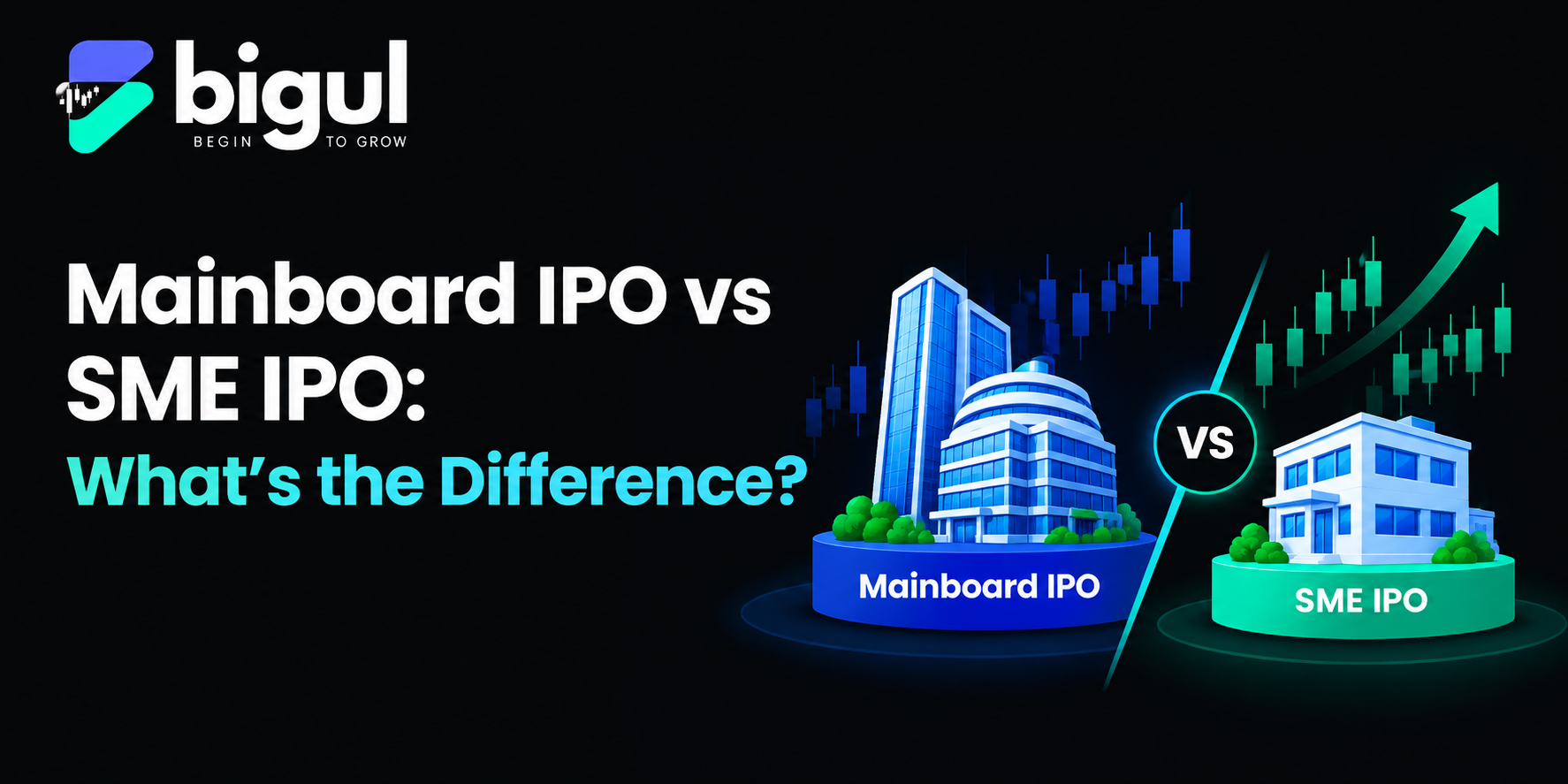
Mainboard IPO vs SME IPO: Understanding the Key Differences
When a company decides to go public in India, it has two routes available: The Mainboard and the SME platform. Both involve listing on a stock exchange. Both give retail investors a chance to participate. But the companies, the regulations, the risks, and the investment experience are meaningfully different.
Understanding which type of IPO you are looking at before you apply is one of the most practical things any investor can know.
What Is a Mainboard IPO?
A Mainboard IPO is the listing of a larger, more established company on the main trading platform of NSE or BSE.
These are companies that have already built scale with revenues, profitability track records, and institutional backing and are now offering shares to the public to raise significant capital, provide early investor exits, or fund the next phase of growth.
SEBI's regulatory framework for Mainboard IPOs is the most stringent in India's capital market system. The disclosures are extensive, the scrutiny is thorough, and the eligibility criteria are demanding.
What Is an SME IPO?
An SME IPO is the listing of a smaller company on the dedicated SME platforms; BSE SME or NSE Emerge, specifically designed for small and medium enterprises.
These are companies at an earlier stage of their journey. Lower revenues. Often in niche sectors or regional markets. The SME platform gives them access to public capital without meeting the demanding eligibility requirements of the Mainboard.
India had 196 SME IPOs in FY26 more than the 109 Mainboard IPOs in the same year. The SME segment has grown dramatically fuelled by investor appetite for smaller companies with higher growth potential.
Key Differences — Mainboard vs SME IPO
|
Factor |
Mainboard IPO |
SME IPO |
|
Exchange platform |
NSE / BSE main platform |
BSE SME / NSE Emerge |
|
Minimum issue size |
No lower limit — typically ₹10 crore and above |
Up to ₹25 crore |
|
Maximum issue size |
No upper limit |
Up to ₹25 crore |
|
Minimum lot size |
Typically ₹13,000 to ₹15,000 |
Higher — typically ₹1 lakh to ₹1.5 lakh |
|
DRHP filed with |
SEBI |
Stock exchange (BSE or NSE) |
|
Market maker required |
No |
Yes — mandatory |
|
Underwriting |
Not mandatory |
Mandatory — 100% underwritten |
|
Liquidity |
High — large trading volumes |
Lower — thinner trading volumes |
Eligibility Requirements — The Key Distinction
For Mainboard IPOs — SEBI requires one of the following:
The company must have net tangible assets of at least ₹3 crore in each of the preceding three years, distributable profits in at least three of the immediately preceding five years, and a net worth of at least ₹1 crore in each of the preceding three years.
Alternatively, companies can list without a profitability track record if the issue is entirely through the book-building route and QIBs are allocated at least 75% of the net offer.
For SME IPOs — requirements are significantly more accessible:
Positive net worth. Application supported by at least 15% of the total issue size from QIBs or underwriters. The company must have been incorporated for at least three years. These requirements are considerably more achievable for early-stage businesses.
The Minimum Investment Difference
For Mainboard IPOs — the minimum lot size is typically structured so that the minimum application amount falls in the range of ₹13,000 - ₹15,000. For the NSE IPO, the minimum is ₹14,280 for one lot of 8 shares.
For SME IPOs — the minimum lot size is significantly higher often ₹1 lakh - ₹1.5 lakh or more. SEBI has structured SME IPOs with higher minimum investment thresholds to limit retail participation in higher-risk offerings recognising that SME companies carry meaningfully more risk than Mainboard companies.
The Risk Difference
SME IPOs carry significantly higher risk than Mainboard IPOs for several reasons.
Shorter track records: Many SME companies have been operating for only three to five years. The business model has not been tested across multiple economic cycles.
Lower liquidity: SME stocks trade on thinner volumes. Selling a position in an SME stock can be significantly more difficult than selling a Mainboard-listed stock.
Higher price volatility: With fewer shares in circulation and lower trading volumes, SME stocks can move dramatically in both directions — sometimes within a single session.
Regulatory differences: Mainboard IPOs go through SEBI's most rigorous approval process. SME IPOs are reviewed by the stock exchanges — which have a lighter-touch framework.
Grey Market Premium — How It Differs
Grey market premiums exist for both Mainboard and SME IPOs but the SME GMP can be significantly more volatile and less indicative of actual listing performance.
Because SME stocks have lower liquidity and thinner trading, the GMP can spike dramatically on very small trading volumes. A high SME GMP should be treated with even more caution than a high Mainboard GMP.
Which Should You Apply For?
Mainboard IPOs are more suitable if:
-
You are a first-time IPO investor
-
You prioritise liquidity, the ability to exit easily after listing
-
You prefer companies with established track records & institutional backing
SME IPOs may be worth considering if:
-
You are an experienced investor comfortable with higher risk
-
You have researched the specific company thoroughly including reading the full prospectus
-
You can afford to hold the position for an extended period if liquidity is limited
FAQs
Can retail investors apply for SME IPOs?
Yes, but the minimum lot size is significantly higher than Mainboard IPOs, typically ₹1 lakh- ₹1.5 lakh.
Are SME IPO gains tax-free?
No. SME IPO gains are taxed identically to Mainboard IPO gains, LTCG at 12.5% above ₹1.25 lakh for holdings over 12 months, STCG at 20% for holdings under 12 months.
Why is a market maker mandatory for SME IPOs?
SME stocks have lower natural trading volumes. A market maker, a broker designated to provide continuous buy and sell quotes ensures some baseline liquidity in the stock even when natural trading interest is thin.
What is the maximum size of an SME IPO?
SEBI caps SME IPOs at ₹25 crore. Companies wanting to raise more than ₹25 crore must migrate to the Mainboard platform.
Explore :- start your first investment through Bigul