



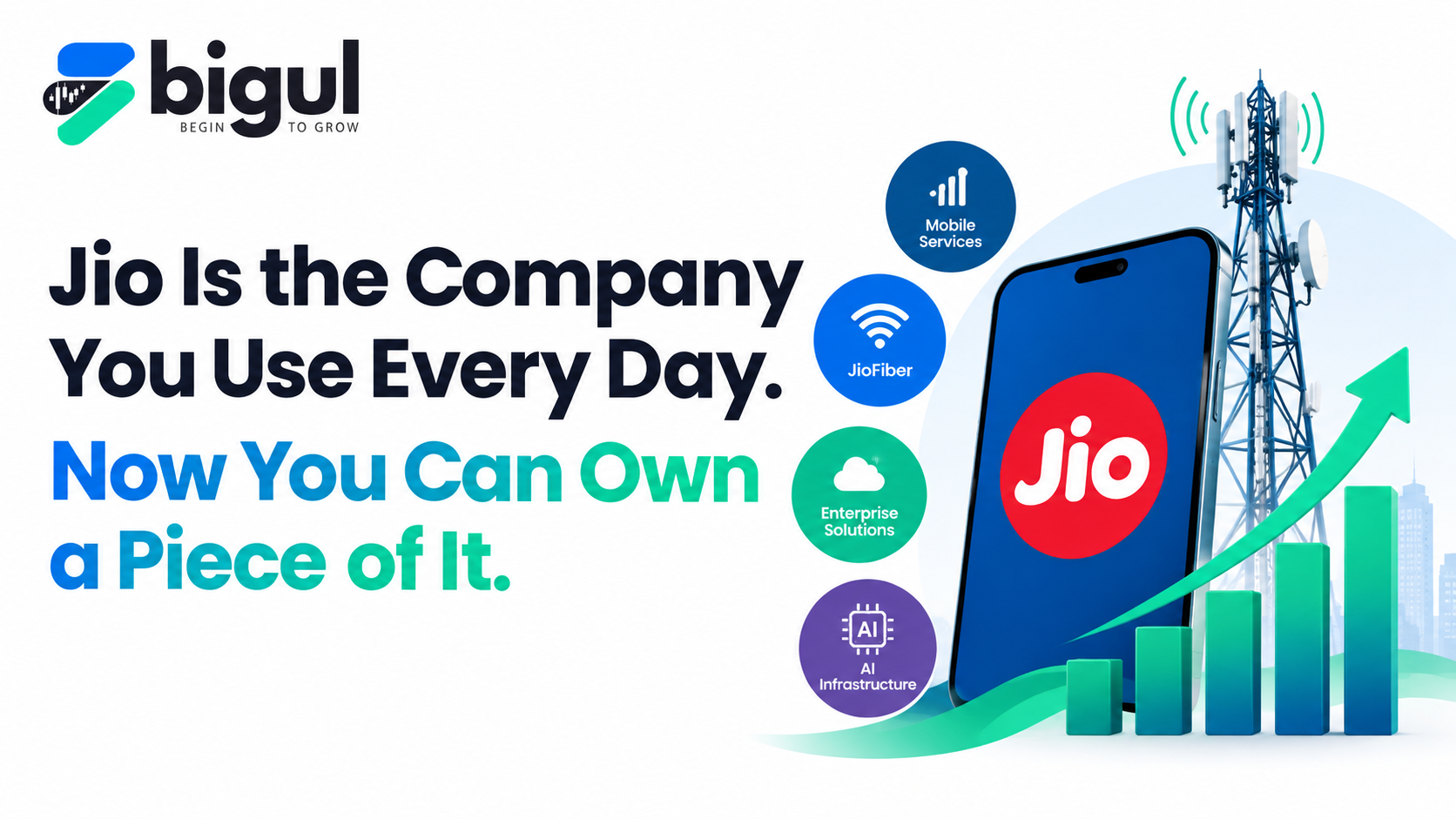
Jio Is the Company You Use Every Day. Now You Can Own a Piece of It.
 19-Oct-2026
 2 mins read
Trending Now
-
Turtlemint Fintech Solutions IPO GMP, Open Date, Price Band, Issue Size 18-Jun-2026
-
.jpg)
SpaceX IPO: Elon Musk Becomes World's First Trillionaire — Key Facts Explained 13-Jun-2026
-
Zepto IPO, Open Date, Issue Size, Price Band and UDRHP Filed 12-Jun-2026
-
Shah Metacorp Rights Issue May 2026 Details, Record Date, Issue Price 26-May-2026
-
Jio Is Going Public. Here's What That Actually Means for You 11-May-2026
-
Parle Products IPO: India’s Most Iconic Biscuit Brand Going Public? 30-Apr-2026
-
Gujarat Cotex Rights Issue 2026 Details, Record Date, Issue Price 27-Mar-2026
-
.jpg)
Avi Polymers Rights Issue 2026 Details, Record Date, Issue Price 11-Feb-2026
-

D & H India Rights Issue 2026 Details, Record Date, Issue Price 05-Feb-2026
-

Avasara Finance Rights Issue 2025 Details, Record Date, Issue Price 29-Dec-2025
Jio Platforms IPO 2026: Key dates, price band, valuation, growth opportunities and risks investors should understand.
India’s most talked-about IPO in years is going to open for subscription .
Jio Platforms IPO opens on October 21 and closes on October 23 with a price band of ₹1,065 to ₹1,119 per share. At the upper end, the issue values Jio Platforms at around ₹10.3 lakh crore.
The lot size is 12 shares, meaning the minimum investment at the upper price band is ₹13,428. Listing on BSE & NSE is tentatively scheduled for October 28. Jio IPO
Mukesh Ambani has reportedly urged all 4.2 lakh Reliance employees to invest in the IPO even paying their salaries in advance.
But before you hit apply, here is what the excitement can make it easy to miss.
What Jio Actually Is
Most Indians use Jio every day without thinking about it.
448 million subscribers. India’s largest mobile network operator. The company that made the internet effectively free in 2016 and rewired how an entire country consumes data.
Now Jio Platforms, the entity going public, is bigger than just the telecom business.
It is the holding company for Jio’s digital ecosystem. The telecom business. JioFiber. JioAirFiber. Enterprise connectivity. AI infrastructure. And strategic investors that includes Meta at 9.98% and Google at 7.73%.
The IPO is a fresh issue of shares worth ₹30,213 crore with ₹27,500 crore of those proceeds earmarked for one specific purpose.
Paying down debt. Paying back what was borrowed to build what already exists.
That is not necessarily a bad thing. Lower debt means lower interest costs which means more cash available for future investments. But it is worth understanding what you are funding when you apply.
The Business Case — Why Jio Is Genuinely Interesting
The numbers behind Jio’s business are genuinely compelling.
EBITDA minus capex — the metric that shows how much cash a telecom company generates after maintaining and building its network stood at ₹42,071 crore in FY26.
More importantly, it is growing fast. Jio overtook Airtel’s India business on this metric for the first time in Q1 FY27, with Jio’s figure at ₹16,681 crore compared to Airtel’s ₹14,102 crore.
Capital expenditure is falling. From ₹53,510 crore in FY24 to ₹34,184 crore in FY26. When a telecom company finishes building its network, spending falls and cash generation rises. Jio appears to be entering that phase.
5G adoption, home broadband expansion through JioFiber and JioAirFiber, enterprise cloud services, and AI infrastructure is a genuine growth runway that India’s scale makes uniquely credible.
Three Things to Look at Carefully
1. Jio sells its recharge vouchers entirely through one distributor — Reliance Retail.
When you recharge your Jio plan, the money doesn’t go straight to Jio. Jio sells vouchers in bulk to Reliance Retail, which then distributes them through stores, apps and online channels. Reliance Retail pays Jio upfront which keeps Jio’s cash position strong. But prepaid plans account for approximately 77% of Jio’s telecom revenue and Reliance Retail is the only distributor for all of it.
If that arrangement ever changes, Jio would need to build an entirely new distribution network from scratch.
2. EBITDA minus capex grew 111%. Profits grew 15%.
While Jio was building its 5G network, interest on the loans funding it could be capitalised into the asset. Now that the network is operational that interest shows up as an expense. Finance costs jumped 76% to ₹8,653 crore in FY26. Depreciation rose 13% as newer equipment began to be written off.
EBITDA minus capex is a genuinely useful metric for telecom. But it is not entirely free cash either. Taxes, future spectrum purchases, and the AI investments Reliance has promised will all reduce what is actually available.
3. The valuation assumes a growth story that has not fully arrived yet.
At the upper price band, Jio Platforms is valued at around ₹10.3 lakh crore creating a standalone market benchmark for a business that has so far been housed within Reliance Industries. Jio platforms IPO
At approximately 34 times earnings, Jio’s PE is lower than Airtel’s 41 times. On EV/EBITDA Jio trades at approximately 12 times FY28 expected earnings versus Airtel’s 10 times.
But Airtel currently has higher EBITDA margins approximately 57% versus Jio’s 50% and faster profit growth.
Jio’s valuation is not pricing what it is today. It is pricing what investors believe it could become, the AI infrastructure layer, the digital services platform, the 5G enterprise business.
What This IPO Means Beyond the Application
There is a broader significance to this listing that goes beyond whether you apply or not.
For years, Jio’s value has been buried inside Reliance Industries. Analysts could estimate it. Brokerages could model it. But there was no market price.
After October 28 — there will be.
A standalone listing creates transparency. It creates a reference price for Jio’s value that every future transaction partnerships, acquisitions, spectrum deals will be measured against. It also allows investors who specifically want Jio exposure to own it directly rather than through the Reliance conglomerate.
That is a separate investment decision from the Jio IPO itself. But it is part of the same story.
Key IPO Details
|
Metric |
Details |
|
IPO open date |
October 21 2026 |
|
IPO close date |
October 23 2026 |
|
Price band |
₹1,065 to ₹1,119 per share |
|
Lot size |
12 shares |
|
Minimum investment |
₹13,428 at upper band |
|
Issue size |
₹30,213 crore |
|
Listing date |
October 28 2026 — BSE and NSE |
FAQs
Why is Jio raising money through an IPO?
The IPO is a fresh issue, Jio is issuing new shares to raise ₹30,213 crore. Of that, ₹27,500 crore will be used to repay debt of Reliance Jio Infocomm. Lower debt means lower interest costs which improves free cash flow and financial flexibility for future investments.
Can RIL shareholders get a special allocation in the Jio IPO?
Yes: ₹2,500 crore of the issue is reserved for Reliance Industries shareholders. If you hold RIL shares as of the record date, you are eligible to apply in this reserved category.
Explore more : SME IPO VS Mainboard IPO