



Present Bias in Investing: Why “Next Month” Costs You
 16-Nov-2026
 2 mins read
Trending Now
-

Turtlemint Fintech Solutions IPO GMP, Open Date, Price Band, Issue Size 18-Jun-2026
-
.jpg)
SpaceX IPO: Elon Musk Becomes World's First Trillionaire — Key Facts Explained 13-Jun-2026
-

Zepto IPO, Open Date, Issue Size, Price Band and UDRHP Filed 12-Jun-2026
-

Shah Metacorp Rights Issue May 2026 Details, Record Date, Issue Price 26-May-2026
-

Jio Is Going Public. Here's What That Actually Means for You 11-May-2026
-

Parle Products IPO: India’s Most Iconic Biscuit Brand Going Public? 30-Apr-2026
-
Gujarat Cotex Rights Issue 2026 Details, Record Date, Issue Price 27-Mar-2026
-
.jpg)
Avi Polymers Rights Issue 2026 Details, Record Date, Issue Price 11-Feb-2026
-

D & H India Rights Issue 2026 Details, Record Date, Issue Price 05-Feb-2026
-

Avasara Finance Rights Issue 2025 Details, Record Date, Issue Price 29-Dec-2025

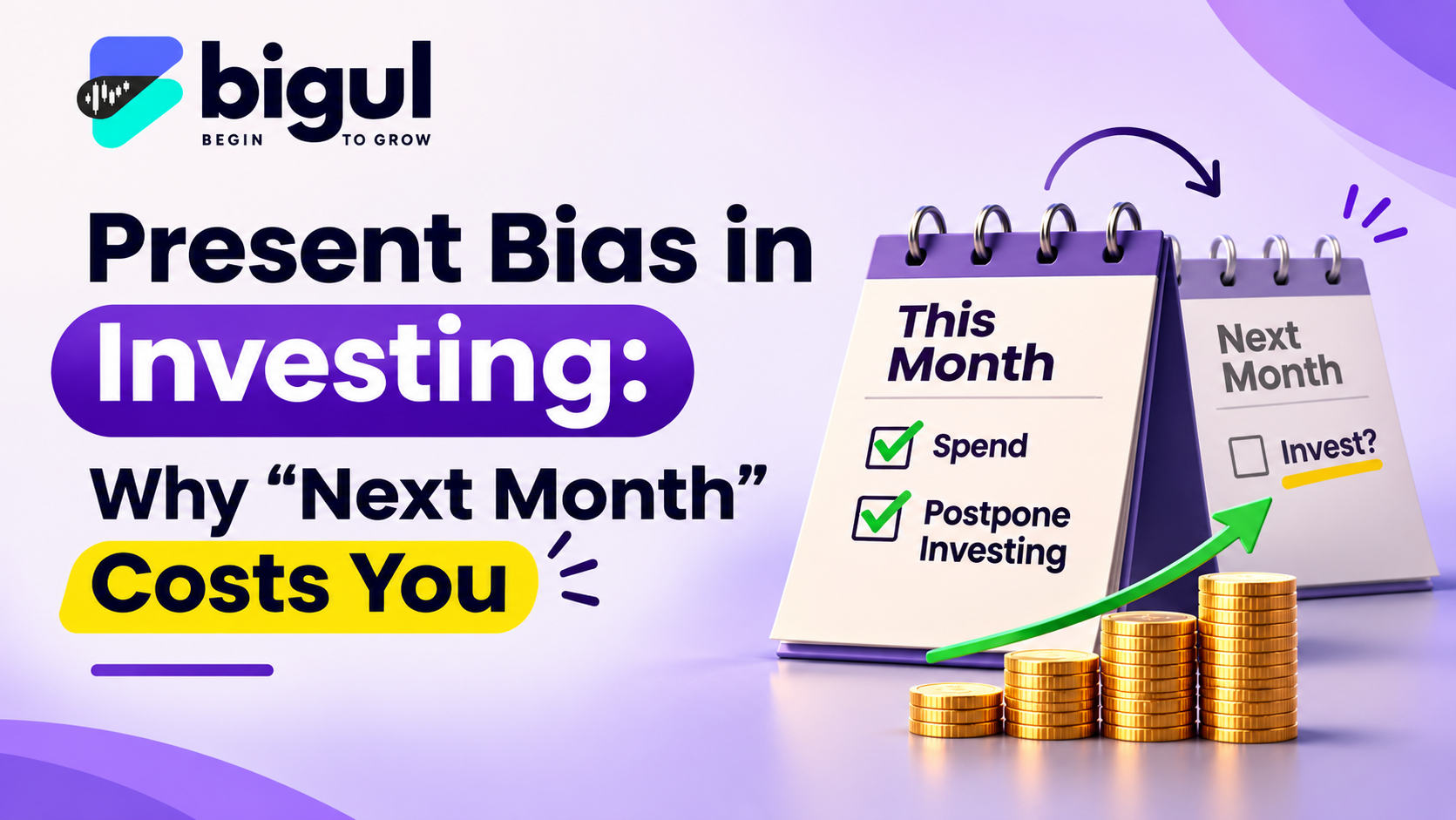
“I’ll start my SIP next month.”
You have said it. Everyone has.
It sounds harmless as it is just one month, what could it cost?
Take a ₹10,000 monthly SIP over 20 years, assuming 12% a year. The first instalment you skip is not a ₹10,000 problem. By the end, that single instalment would have been worth about ₹1.1 lakh.
Say “next month” twelve times and you have delayed a full year, which costs about ₹12.3 lakh.
Psychologists call this habit present bias, and it is the reason so many of us keep delaying a SIP.
Key takeaways
-
Present bias is our habit of favouring now over later, so we put off investing.
-
On a ₹10,000 SIP over 20 years, a one-year delay costs about ₹12.3 lakh, and a five-year delay nearly halves the final corpus.
-
Good intentions are not enough: in one study, 35% of under-savers planned to save more, yet 86% of them had changed nothing four months later.
-
Automating the start, and the increase, beats willpower.
What Is Present Bias?
Present bias is the tendency to give more weight to rewards and costs now than to those in the future, so we put off things that pay later, like investing, and favour things that pay now, like spending.
It is the psychological principle in which we heavily discount the future.
Here is a simple way to see it. Would you take ₹1,000 today or ₹1,100 next week? Many people take ₹1,000 today. Now ask: ₹1,000 in 52 weeks or ₹1,100 in 53 weeks? Almost everyone picks the bigger amount. The gap is the same one week, but once “now” is on the table, patience disappears.
Economists describe this pattern as hyperbolic discounting.
Why Do We Keep Saying “Next Month”?
Because next month always looks easier than this one. Future-you seem to have more money, fewer bills and more energy. Then next month arrives, becomes “now,” and the cycle repeats.
The research shows how common it is. Among self-reported under-savers, 35% said they intended to raise their savings rate in the next few months, but 86% of those well-intentioned savers had made no change four months later.
Intentions were never the problem. The date was.
What Does Delaying a SIP Actually Cost?
Here is what a ₹10,000 monthly SIP becomes if you start today, or later, while still stopping on the same date 20 years from now:
|
Start |
Months invested |
Total invested |
Corpus after 20 years |
Cost of waiting |
|
Today |
240 |
₹24.0 lakh |
₹98.9 lakh |
n/a |
|
1 month later |
239 |
₹23.9 lakh |
₹97.8 lakh |
₹1.1 lakh |
|
6 months later |
234 |
₹23.4 lakh |
₹92.6 lakh |
₹6.3 lakh |
|
1 year later |
228 |
₹22.8 lakh |
₹86.7 lakh |
₹12.3 lakh |
|
3 years later |
204 |
₹20.4 lakh |
₹66.1 lakh |
₹32.8 lakh |
|
5 years later |
180 |
₹18.0 lakh |
₹50.0 lakh |
₹49.0 lakh |
Illustrative: 12% a year compounded monthly, instalments at month-end. Returns are not guaranteed, and a SIP does not assure profit or protect against loss.
Look at the last row. You invest only ₹6 lakh less, yet the final corpus is nearly halved. The instalments you skip are the ones with the longest time to grow.
How to Beat Present Bias: 5 Ways to Automate Your Investing
1. Set up the auto-debit today.
Do not rely on remembering each month. Pick a date just after your salary arrives and let the SIP mandate run, so the decision is made once.
2. Start small, but start.
Even a small SIP builds the habit, and you can raise it later. The table shows that the date you begin matters more than the amount.
3. Let future-you raise it.
Present bias hates sacrifice now, but accepts it later. In the Save More Tomorrow programme, designed by Richard Thaler and Shlomo Benartzi, workers committed in advance to raise their savings with future pay rises. 78% of those offered the plan joined, 80% stayed through four pay raises, and average savings rates rose from 3.5% to 13.6% over 40 months. In India, a step-up SIP does the same, raising the instalment automatically each year.
4. Make investing the default.
When saving is automatic, people do it. In one US retirement plan studied by economists Brigitte Madrian and Dennis Shea, participation among newly eligible workers rose from 49% to 86% once enrollment became automatic. Do the same at home: move money to your investments first, and spend what is left.
5. Replace “next month” with a date.
“Next month” is a mood. “On the 5th” is a plan. Write the date and tell someone.
Quick Self-Test: Is Present Bias Costing You?
-
Have you said “next month” about investing more than once?
-
Do you wait for a “better time,” such as a bonus or a lower market?
-
Is your SIP still at its starting amount from years ago?
-
Do you spend first and invest whatever is left?
If you said yes to two or more, an automatic start and an automatic increase will help.
FAQs
What is the present bias in investing?
It is the tendency to favour rewards now over larger rewards later, which makes us put off investing and spend instead.
How much does delaying a SIP by a year cost?
On a ₹10,000 monthly SIP over 20 years at an assumed 12% a year, starting one year late reduces the corpus from about ₹98.9 lakh to about ₹86.7 lakh, a cost of about ₹12.3 lakh. The returns are illustrative and not guaranteed.
How do I stop procrastinating on investing?
Remove the monthly decision. Set up an auto-debit, start with a small amount, and add a step-up so the SIP grows with your income.