


No-Code Algo Trading: Build a Trading Strategy Without Writing a Single Line of Code
 11-Aug-2026
 2 mins read
Trending Now
-

Turtlemint Fintech Solutions IPO GMP, Open Date, Price Band, Issue Size 18-Jun-2026
-
.jpg)
SpaceX IPO: Elon Musk Becomes World's First Trillionaire — Key Facts Explained 13-Jun-2026
-

Zepto IPO, Open Date, Issue Size, Price Band and UDRHP Filed 12-Jun-2026
-
Shah Metacorp Rights Issue May 2026 Details, Record Date, Issue Price 26-May-2026
-

Jio Is Going Public. Here's What That Actually Means for You 11-May-2026
-

Parle Products IPO: India’s Most Iconic Biscuit Brand Going Public? 30-Apr-2026
-
Gujarat Cotex Rights Issue 2026 Details, Record Date, Issue Price 27-Mar-2026
-
.jpg)
Avi Polymers Rights Issue 2026 Details, Record Date, Issue Price 11-Feb-2026
-

D & H India Rights Issue 2026 Details, Record Date, Issue Price 05-Feb-2026
-

Avasara Finance Rights Issue 2025 Details, Record Date, Issue Price 29-Dec-2025

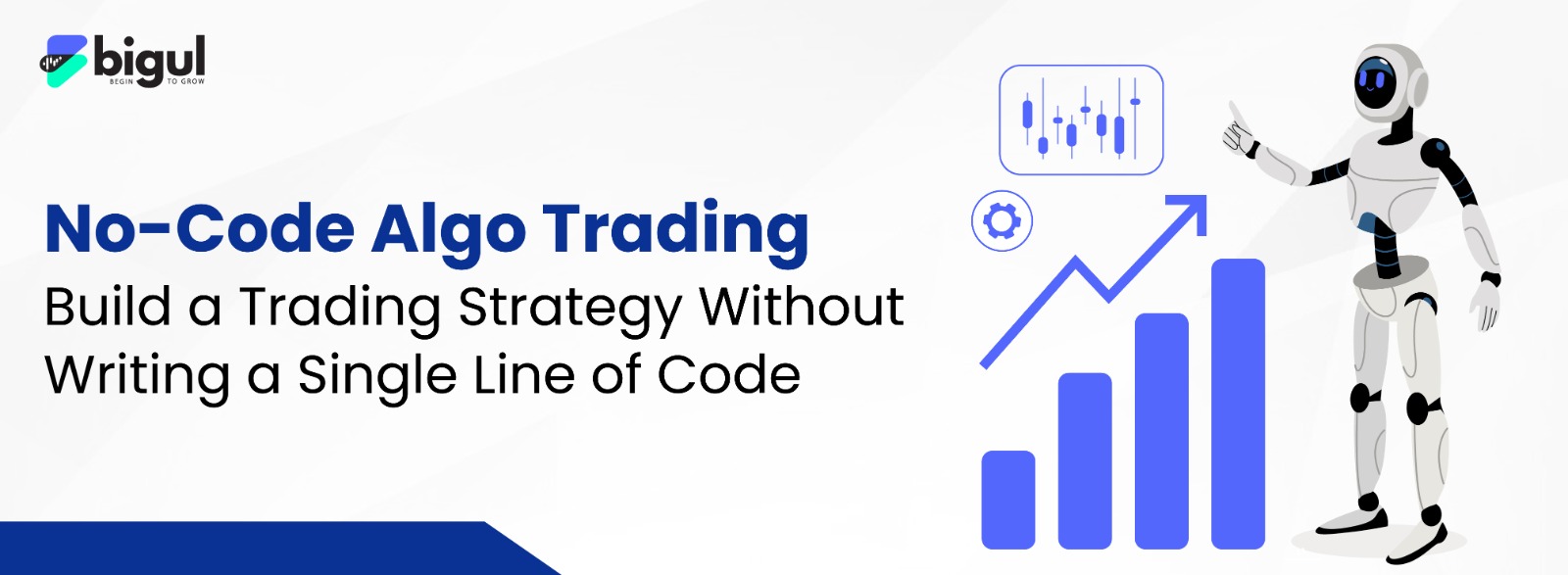
Build and automate trading strategies without writing a single line of code using a no-code algo strategy builder.
Most traders who hear the words "algo trading" assume one thing.
You need to know how to code.
Python. APIs. Complex algorithms.
None of that is true anymore and that shift has opened algorithmic trading to an entirely new kind of trader.
What Is No-Code Algo Trading
No-code algo trading is exactly what it sounds like building, testing, and running automated trading strategies without writing a single code.
Instead of scripting rules in Python or C++, you use a visual interface. You drag indicators onto a canvas, set conditions using dropdowns, define your entry and exit logic through simple rule-based selections, and the platform translates everything into a working algorithm behind the scenes.
The process is accessible to anyone who understands markets, regardless of whether they understand programming.
Why Retail Traders Are Moving Away from Manual Coding
Learning to code a trading strategy from scratch takes months.
Coding skill and trading skill are two completely different things. A trader who has spent years understanding price action, technical indicators, and risk management should not have to become a software developer just to automate what they already know.
Algo trading without coding removes that barrier entirely. The trader focuses on the strategy. The platform handles the technical execution.
How No-Code Strategy Builders Work (Drag-and-Drop / Rule-Based Logic)
A drag-and-drop strategy builder works on a simple principle: everything you would normally write in code, you configure visually instead.
Here is how it works:
You start with a blank canvas. You select your instrument — equity, futures, or options. Then you start defining your strategy logic by selecting from pre-built blocks:
Indicators: RSI, MACD, Bollinger Bands, Moving Averages selected from a library of 30+ technical indicators.
Conditions: "RSI crosses above 30" or "price closes above 20-day moving average", set using dropdown menus and inputs.
Actions: "Place stop loss at X% below entry", configured with fields, not formulas.
Triggers: Time-based, price-based, or volume-based conditions that activate the strategy.
Once configured, the platform converts your visual rules into executable logic and runs the strategy automatically when conditions are met.
Step-by-Step: Building a Strategy Using Bigul Algos (No Code)
Here is how to build a trading strategy without code on Bigul:
Step 1: Log in to your Bigul account and navigate to the Algo Strategy Builder.
Step 2: Select your instrument and timeframe
Step 3: Choose your technical indicators from the library. Drag them onto the strategy canvas.
Step 4: Define your entry condition.
Step 5: Define your exit condition.
Step 6: Set your stop loss, target, and position size using the configuration panel.
Step 7: Save the strategy. Before going live, run a backtest.
Setting Entry/Exit Conditions, Stop Loss & Targets Visually
In a coded strategy, every condition is a line of logic that needs to be written correctly. One syntax error breaks the entire strategy.
In Bigul's visual builder, you set the same conditions through input fields and dropdowns:
Entry condition: Select your indicator, trigger event (crosses above / crosses below / equals), enter the value.
Exit condition: Same process. Define what has to happen for the trade to close.
Stop loss: Enter a percentage below entry or a fixed price level. The platform applies it automatically to every trade the strategy executes.
Target: Set a profit target and the strategy closes the position when it is hit.
Every condition you set visually is applied consistently to every trade.
Backtesting and Paper Trading Before Going Live
Before any real capital is involved, Bigul allows you to test your strategy against historical market data.
Backtesting runs your strategy through past data and shows you how it would have performed. You get a full performance breakdown; total trades, average profit per trade, drawdowns, and net return.
A strategy that looks logical on paper can perform very differently in actual market conditions. Backtesting surfaces those gaps before they cost you money.
Key things to check in your backtest results:
-
Win rate — what percentage of trades were profitable?
-
Drawdown — how much did the strategy lose at its worst point?
-
Trade frequency — is the strategy triggering too often or too rarely?
-
Risk-reward ratio — are average winners larger than average losers?
Bigul offers backtesting at no additional cost for account holders.
No-Code vs Code-Based Algo Trading — Pros & Cons
|
Factor |
No-Code |
Code-Based |
|
Learning curve |
Low — hours to days |
High — weeks to months |
|
Flexibility |
Moderate — within platform capabilities |
High — unlimited customisation |
|
Maintenance |
Platform handles it |
Trader maintains the code |
|
Cost |
Usually free or low cost |
Development time + maintenance |
|
Best for |
Retail traders, beginners, active traders |
Quant developers, HFT firms |
Common Mistakes Beginners Make with No-Code Strategies
Getting the platform right is the easy part. Getting the strategy right is the work.
Over-optimising during backtesting — Adjusting parameters until the backtest looks perfect is called curve-fitting. The strategy performs beautifully on historical data and poorly on live markets.
Skipping the backtest entirely — Going live without testing is the most expensive shortcut a trader can take.
Too many indicators — Adding five indicators to confirm a single signal does not make the strategy more accurate. It usually makes it slower to trigger and less effective overall.
No risk controls defined — A strategy without a stop loss or daily loss limit is not automated trading. It is automated risk-taking.
Not accounting for slippage — Live market execution is never as clean as a backtest. Factor in the gap between your theoretical entry price and actual execution price when evaluating results.
The Bottom Line
Algo trading for beginners in India is no longer blocked by the need to learn programming. The tools exist. The platforms are accessible and the quality of a no-code strategy is determined by the quality of your trading logic, not the quality of your code.
Build your strategy. Test it on historical data. Start with a small position size. Let the platform execute while you monitor.
Open Your Bigul Account and Start Building Your No-Code Strategy Today →