


Manual Trading vs Algo Trading: Which Is Better in 2026?
 03-Jul-2026
 2 mins read
Trending Now
-

Turtlemint Fintech Solutions IPO GMP, Open Date, Price Band, Issue Size 18-Jun-2026
-
.jpg)
SpaceX IPO: Elon Musk Becomes World's First Trillionaire — Key Facts Explained 13-Jun-2026
-

Zepto IPO, Open Date, Issue Size, Price Band and UDRHP Filed 12-Jun-2026
-
Shah Metacorp Rights Issue May 2026 Details, Record Date, Issue Price 26-May-2026
-

Jio Is Going Public. Here's What That Actually Means for You 11-May-2026
-

Parle Products IPO: India’s Most Iconic Biscuit Brand Going Public? 30-Apr-2026
-
Gujarat Cotex Rights Issue 2026 Details, Record Date, Issue Price 27-Mar-2026
-
.jpg)
Avi Polymers Rights Issue 2026 Details, Record Date, Issue Price 11-Feb-2026
-

D & H India Rights Issue 2026 Details, Record Date, Issue Price 05-Feb-2026
-

Avasara Finance Rights Issue 2025 Details, Record Date, Issue Price 29-Dec-2025

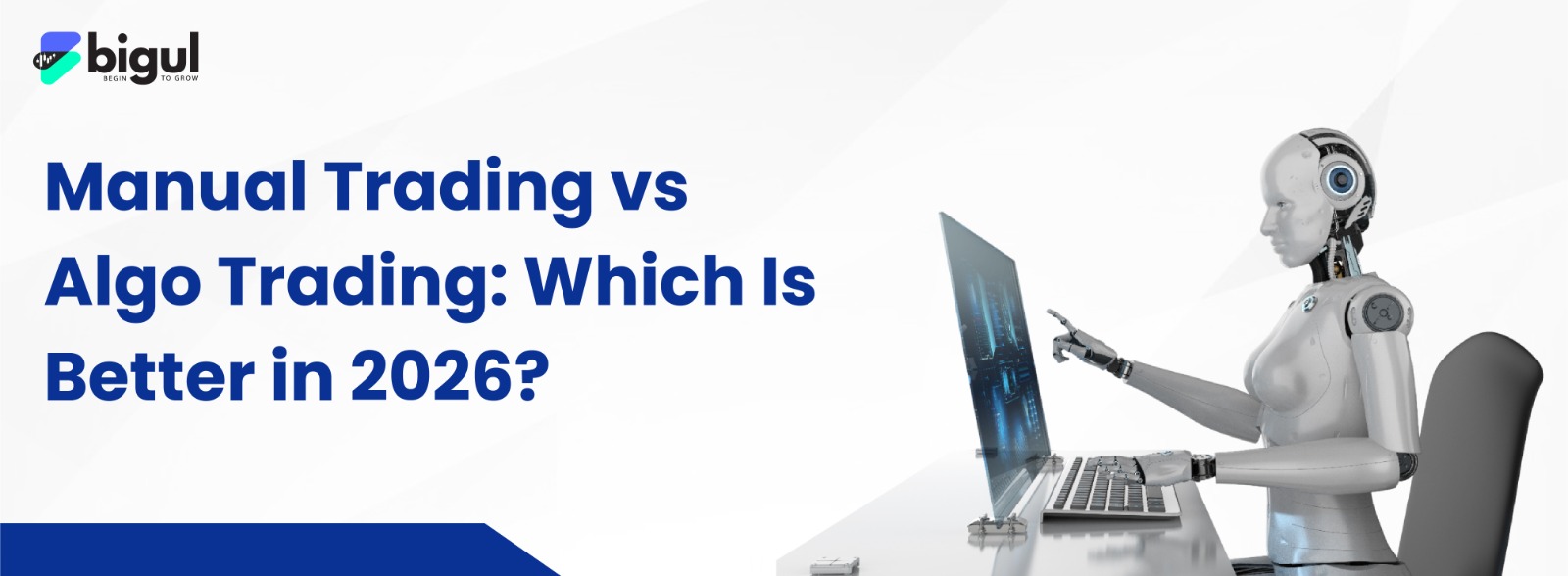
Manual Trading vs Algo Trading: Compare speed, risk, automation, costs, and profitability to choose the right trading approach in 2026.
Manual trading and algo trading both works. The difference is in what they're built for — and matching the right method to your strategy, skill level, and market conditions is what actually determines the results.
The thing that really matters is which method fits your strategy, your skill set, your available time, and the market conditions you trade in. A discretionary trader with ten years of price action experience can outperform a poorly-built algorithm. A well-coded system with strict risk rules will beat an emotional manual trader in a trending, data-driven market every single time.
This guide breaks down both approaches clearly: where each one performs best, what each one costs, and a straightforward framework for deciding which fits where you are right now.
What Is Manual Trading? (Discretionary Trading Explained)
Manual trading — also called discretionary trading — means you analyse the market yourself, identify setups, and place trades by hand. Every decision — entry, exit, stop, position size — is yours in real time. No programming knowledge needed, no expensive infrastructure.
Manual trading example: a trader studies price action every morning, tries to look a breakout setup on Nifty index, places the order manually through their broker, and manages the trade until the target or stop is hit.
1) Where Manual Trading Wins
- News/event-based markets: If RBI announces something unexpected or a company surprises with earnings, a person can understand the reason behind it and respond appropriately. The computer simply knows whether its parameters are being fulfilled but has no idea why the price of that candle changed by 3%.
- Illiquid securities: In low-volume markets, order flow from algorithms is changing prices itself. People can make selective decisions which cannot be made by machines.
- Creating market knowledge: Trading manually makes one aware of the reasons behind changes in price. Jumping directly into algorithmic trading without having this background makes it much harder to find the reason for algorithmic problems.
2) Common Manual Trading Mistakes to Avoid
Manual trading psychology is where most traders come undone — not because of bad strategy, but execution under pressure:
- Emotional trading — cutting winners short out of fear, holding losers hoping for a reversal
- Revenge trading — increasing size after a loss to recover quickly
- Inconsistency — the same trader executes differently on Monday versus Friday after three losing sessions
Studies consistently show 70–80% of retail traders lose money, and emotional trading vs algorithmic trading comes down to exactly this gap.
What Is Algo Trading? (Systematic Trading Explained)
Algo trading — or systematic trading — uses software to execute trades automatically based on predefined rules. Those rules can be simple ("buy when 20 EMA crosses above 50 EMA") or complex machine-learning models processing multi-factor data in real time.
The core distinction in discretionary trading vs systematic trading is this: discretionary relies on human judgment for every decision; systematic removes the human from execution entirely once the rules are set.
Algorithmic trading in India was opened to retail investors in August 2025 by SEBI with its new framework. Prior to that, algorithmic trading could only be done by institutional players. Now brokers provide the retail investor with API-based services.
1) Where Algo Trading Wins
- Algorithmic processing against manual processing in speed terms: The algorithm executes its trade in milliseconds. In case of a breakout strategy, scalping, or capturing the premium of an option at certain levels, this speed is inherent to algorithms.
- Emotion-free consistency: An algo does not freak out during periods of a drawdown. It will not take revenge trades on the market either. The algo will follow the rules precisely as outlined every single time.
- Backtesting capabilities and 24/7 operation: One has the ability to test an algo on a decade of historical data before putting money into the account. In case of crypto trading, the ability to operate without your participation is indeed a huge advantage.
2) Where Algo Trading Breaks Down
- Black Swan Events: The algorithms rely on past data. In case the market deviates from the usual behaviour — sudden intervention by the central bank, geopolitical events, etc. — the process continues automatically without the ability to stop. Circuit breakers must be in place.
- Over-optimisation: A strategy looking excellent on historical data may be curve-fitted to past patterns that won't repeat — the most common failure mode in retail algo trading.
- Technical risk and maintenance: Server downtime, API failures, bugs in code — these can compound losses fast in a live market if the system isn't actively monitored. Algo trading is not passive income.
Manual Trading vs Algorithmic Trading: Full Comparison
|
Factor |
Manual Trading |
Algo Trading |
|
Execution speed |
Seconds |
Milliseconds |
|
Emotional control |
Depends on trader |
Built-in |
|
Setup cost |
Low |
Medium to high |
|
Technical skill needed |
Market knowledge |
Market knowledge + coding or no-code tools |
|
Backtesting |
Manual, approximate |
Systematic, precise |
|
News adaptability |
High |
Low without override |
|
Scalability |
2–3 instruments |
Hundreds |
|
24/7 markets |
Not possible |
Possible |
|
Main failure mode |
Emotional decisions |
Overfitting, technical failures |
|
SEBI requirement (India) |
Standard broker account |
SEBI-compliant API platform |
Manual Trading or Algo Trading: Who Should Choose What
1) Choose manual trading if:
- You're still building your understanding of markets and risk management.
- Your strategy requires context and discretion that's hard to codify into rigid rules.
- You trade news events, earnings, or macro-driven setups.
- You don't have the technical background to build and maintain an algo system properly.
2) Choose algo trading if:
- You have a clearly defined, rule-based strategy with no discretionary elements.
- Your edge depends on execution speed — scalping, breakouts, and options premium capture.
- You've already validated the strategy manually and want to remove emotional execution.
- You trade crypto or 24/7 markets where continuous monitoring isn't practical.
Hybrid Trading Strategy: How Serious Traders Use Both
The most practical answer to manual trading vs algo trading profitability isn't choosing one — it's building a hybrid trading strategy that uses each method where it's strongest.
It looks something like this:
- Humans manage: Strategy design, interpretation of the regime, determining when to run the strategy, and overriding when conditions become abnormal.
- Algorithms manage: Execution of entry and exits, managing position size, stops, and scanning multiple assets for signals.
A real example: a trader reviews the market each morning, identifies which sectors are in play, activates specific algo strategies for those conditions, monitors through the session, and deactivates when conditions shift. The algo handles the clicks. The trader handles the context — assigning each method the job it's better suited for.
FAQs
1. Can beginners do algo trading?
Yes, but the novice trader should begin by learning how to trade manually first. Without knowing how markets work and risk management practices, it becomes difficult to assess whether an algorithm actually works or whether it is just profitable due to past luck.
2. Should beginners use algo trading directly?
No, because manual trading will teach you price action, market dynamics, and risk management, making you a more successful algo trader later on.
3. Is algo trading better than manual trading for profitability?
Profitability of manual vs algo trading hinges on the quality of the strategy only, irrespective of the means used. The right strategy programmed into an algo will work better than manual trading driven by emotions. An inefficiently programmed algorithm will underperform compared to a disciplined manual trader.
4. Is algo trading legal in India for retail customers?
Yes, algo trading is legalised by SEBI guidelines effective August 2025 for retail customers only by SEBI-approved broker API platforms.
5. Are algo traders required to monitor their algorithms?
Yes, it is essential for algo traders to monitor their systems because of possible system failures, regime shifts, and performance degradation. Strategies successful in trending regimes will perform very poorly in ranging markets.
The Bottom Line: Manual Trading vs Algo Trading
There's no single winner — only the right tool for the right strategy at the right stage of your development.
Start manual. It teaches you things no algorithm can about why markets move and how to manage risk under real pressure. Once you have a proven, rule-based strategy and execution discipline is your biggest gap, automation solves a real problem. The algorithm is only as good as the strategy behind it, and that strategy still requires a trader who understands the market well enough to know when it should and shouldn't run.
The traders consistently performing well in 2026 aren't debating which is better. They're practically using both.