



Stock Market Before vs After CAS
 23-Sep-2026
 2 mins read
Trending Now
-

Turtlemint Fintech Solutions IPO GMP, Open Date, Price Band, Issue Size 18-Jun-2026
-
.jpg)
SpaceX IPO: Elon Musk Becomes World's First Trillionaire — Key Facts Explained 13-Jun-2026
-

Zepto IPO, Open Date, Issue Size, Price Band and UDRHP Filed 12-Jun-2026
-
Shah Metacorp Rights Issue May 2026 Details, Record Date, Issue Price 26-May-2026
-

Jio Is Going Public. Here's What That Actually Means for You 11-May-2026
-

Parle Products IPO: India’s Most Iconic Biscuit Brand Going Public? 30-Apr-2026
-
Gujarat Cotex Rights Issue 2026 Details, Record Date, Issue Price 27-Mar-2026
-
.jpg)
Avi Polymers Rights Issue 2026 Details, Record Date, Issue Price 11-Feb-2026
-

D & H India Rights Issue 2026 Details, Record Date, Issue Price 05-Feb-2026
-
Avasara Finance Rights Issue 2025 Details, Record Date, Issue Price 29-Dec-2025

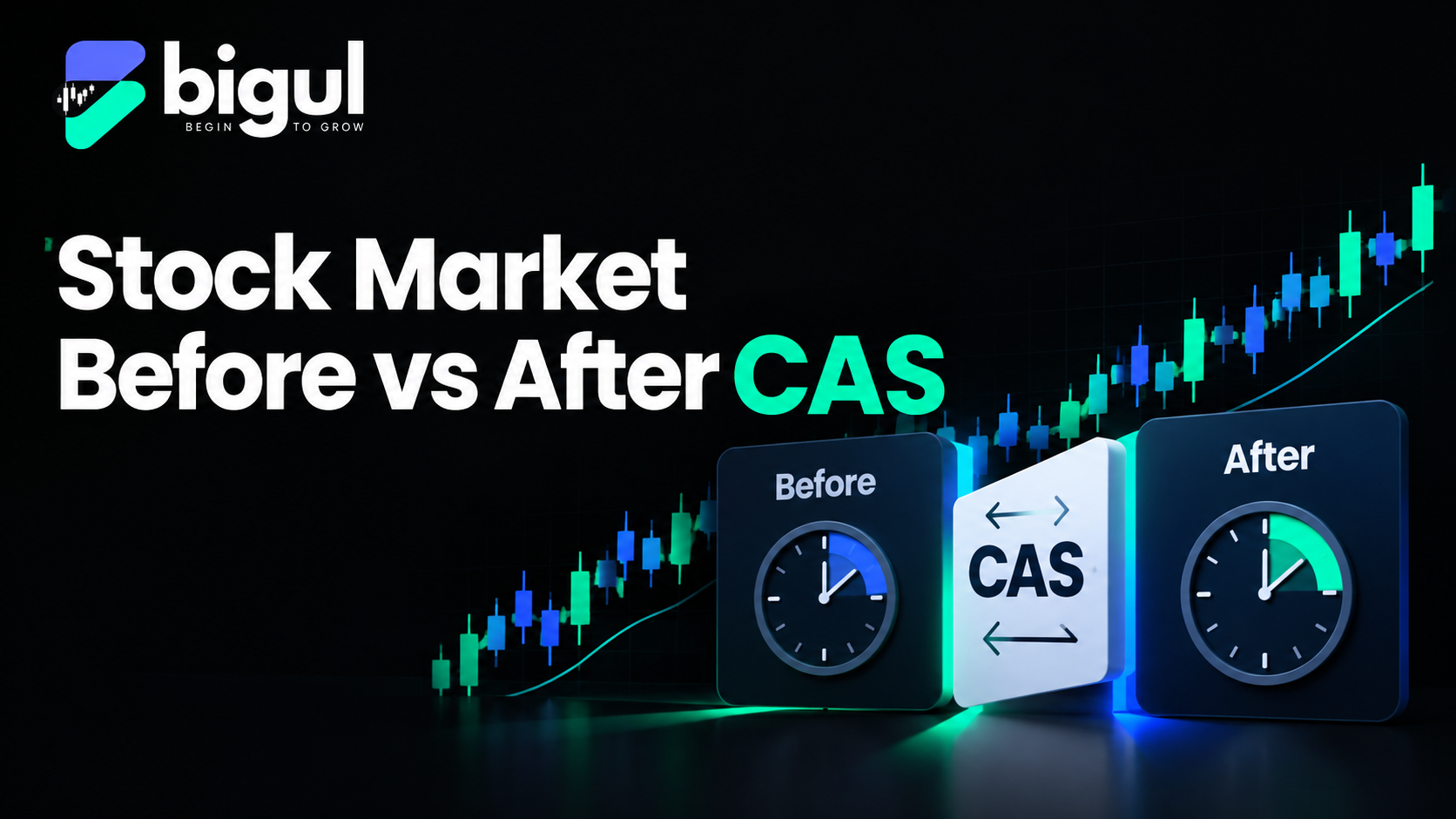
Stock Market Before vs After CAS: Understanding the New Closing Price Mechanism
What if the closing price you see on your screen every day is no longer calculated the way it used to be?
It is not.
And the change that was quiet, technical, and more significant than most people realise happened on August 3 2026.
If you trade F&O stocks, place orders near market close, or simply want to understand how your portfolio's end-of-day value is calculated, this article is worth reading.
How the Closing Price Was Calculated Before CAS
Before August 3 2026, the official closing price of a stock was calculated using the Volume Weighted Average Price of all trades executed in the last 30 minutes of the trading session from 3:00 PM to 3:30 PM.
The VWAP method averaged out the price weighted by volume across those 30 minutes. It was designed to prevent a single large trade at the very end of the session from artificially setting the closing price.
It worked well for most purposes, but it had a structural limitation.
The 30-minute VWAP was a backward-looking calculation; it reflected what had already happened across scattered trades at different times. It didn’t aggregate all buy & sell interest simultaneously into a single price discovery moment.
As Indian markets grew sophisticated, globally connected, and more integrated with passive fund flows that limitation started to matter.
What Is CAS And How Does It Work Now?
Closing Auction Session is a 20-minute session that runs from 3:15 PM to 3:35 PM for all stocks that have Futures and Options contracts on NSE or BSE.
Here is how the new process works:
3:00 PM to 3:15 PM: Continuous trading runs normally. The exchange simultaneously calculates VWAP for these 15 minutes which becomes the reference price for the auction.
3:15 PM: Continuous trading stops for F&O eligible stocks.
3:15 PM to 3:30 PM: Buyers & sellers submit their orders into a single pool. Orders accumulate but are not immediately executed. The exchange calculates and displays an indicative price showing where the market is likely to settle along with total buy & sell quantities and any order imbalance.
3:30 PM to 3:35 PM: Orders are matched at a single equilibrium price, the price at which the maximum number of shares can be traded. This becomes the official closing price for the day.
3:50 PM to 4:00 PM: Post-close session allows eligible trades at the official CAS closing price.
F&O contracts on eligible stocks continue trading until 3:40 PM giving derivatives traders 10 additional minutes to adjust positions while the final closing price of the underlying stock is being determined through CAS.
Before vs After — The Key Differences
|
Factor |
Before CAS |
After CAS |
|
Closing price method |
VWAP of last 30 minutes |
Single auction equilibrium price |
|
Continuous trading ends |
3:30 PM |
3:15 PM for F&O stocks |
|
Price discovery |
Scattered sequential trades |
All orders pooled simultaneously |
|
Indicative price visible |
No |
Yes — during order collection window |
|
F&O trading ends |
3:30 PM |
3:40 PM — 10 minutes extended |
|
Post-close session |
3:40 PM to 3:50 PM |
3:50 PM to 4:00 PM |
|
Stocks covered |
All stocks |
F&O stocks only |
What Has Not Changed?
For stocks that are not in the F&O segment, nothing has changed.
Non-F&O stocks continue trading until 3:30 PM as before. Their closing price is still calculated using the VWAP of the last 30 minutes.
For long-term investors who don’t trade near market close, the practical impact on daily investing is minimal. Your SIP, mutual fund NAV, long-term equity positions all continue to function as before with the added benefit of a more accurately calculated NAV.
Why SEBI Introduced CAS?
The logic behind CAS is well-established globally.
The London Stock Exchange, New York Stock Exchange, Nasdaq, Euronext, Singapore Exchange, Hong Kong Exchange all use closing auctions to determine their official end-of-day prices.
The auction mechanism brings all buyers & sellers into one pool simultaneously rather than allowing the closing price to emerge from scattered sequential trades. The result is a closing price that reflects the collective view of all market participants at a single moment making it fairer, more transparent, and more resistant to last-minute manipulation.
Mutual fund NAVs. ETF valuations. Derivatives settlement. Portfolio collateral.
All of these are calculated using the official closing price. Getting that number right matters — not just for traders, but for every investor whose portfolio value depends on an accurate end-of-day reference.
CAS: What It Means for You
For retail investors:
The timing change is the most important thing to remember.
F&O stocks — continuous trading ends at 3:15 PM. Anything placed after that enters the CAS auction. The mechanics are different — orders accumulate, do not execute immediately, and settle at a single price once the auction closes.
For intraday traders:
Intraday positions in F&O stocks must be squared off before 3:15 PM. The CAS window is not suitable for intraday position management; prices in the auction can behave differently from continuous trading.
For F&O traders:
F&O contracts continue until 3:40 PM. The 10-minute extension gives derivatives traders additional time to hedge or adjust positions while the underlying stock's closing price is being determined.
For mutual fund investors:
NAVs for equity mutual funds & ETFs are now computed using the CAS-derived closing price, making NAV calculations more accurate and transparent.
FAQs
Which stocks are covered under CAS?
All stocks that have Futures & Options contracts on NSE or BSE. Non-F&O stocks continue using the VWAP-based closing price as before.
When did CAS start in India?
August 3 2026; following SEBI's circular dated January 16 2026.
Is my closing price guaranteed during CAS?
No. A market order placed during CAS is not guaranteed to execute at the stock's last traded price before 3:15 PM. The final price depends on the auction equilibrium.
Open a Demat Account with Bigul