



PAN Card Explained: Uses, Benefits, Application Process and Importance for Investing
 24-Jul-2026
 2 mins read
Trending Now
-

Turtlemint Fintech Solutions IPO GMP, Open Date, Price Band, Issue Size 18-Jun-2026
-
.jpg)
SpaceX IPO: Elon Musk Becomes World's First Trillionaire — Key Facts Explained 13-Jun-2026
-

Zepto IPO, Open Date, Issue Size, Price Band and UDRHP Filed 12-Jun-2026
-

Shah Metacorp Rights Issue May 2026 Details, Record Date, Issue Price 26-May-2026
-

Jio Is Going Public. Here's What That Actually Means for You 11-May-2026
-

Parle Products IPO: India’s Most Iconic Biscuit Brand Going Public? 30-Apr-2026
-
Gujarat Cotex Rights Issue 2026 Details, Record Date, Issue Price 27-Mar-2026
-
.jpg)
Avi Polymers Rights Issue 2026 Details, Record Date, Issue Price 11-Feb-2026
-

D & H India Rights Issue 2026 Details, Record Date, Issue Price 05-Feb-2026
-

Avasara Finance Rights Issue 2025 Details, Record Date, Issue Price 29-Dec-2025

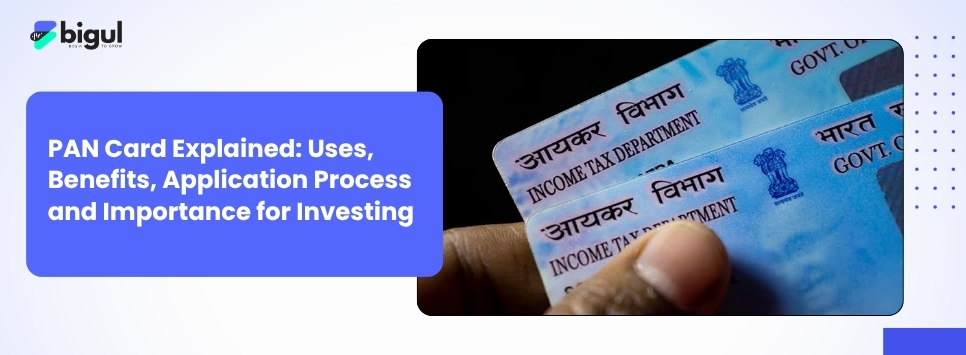
Understand why a PAN Card is essential for investing, opening a demat account, filing taxes, and completing KYC in India.
Most people think of a PAN card as a tax document.
It is actually your gateway to every investment you will ever make in India.
Without a PAN card, you cannot open a demat account, start a SIP, buy stocks, apply for an IPO, or trade in F&O.
Here is everything you need to know.
What is a PAN Card?
PAN (Permanent Account Number) is a 10-digit alphanumeric identifier issued by the Income Tax Department. It links every financial transaction you make to a single identity, making it easier for the government to track income, investments, and tax liability.
From April 2026, new applicants automatically receive PAN 2.0, an upgraded version that enables faster KYC verification.
Why Every Investor Needs a PAN Card
Demat Account
PAN is mandatory for opening a demat account. SEBI requires all investors to be KYC-compliant and PAN is a mandatory part of that process.
Mutual Funds and SIPs
PAN links your investments across all fund houses into one identity. Essential for KYC compliance before any mutual fund investment.
IPO Applications
Every IPO application, whether through ASBA or UPI, requires a valid PAN. No PAN means automatic rejection.
F&O and Derivatives
Investing in derivatives such as options & futures on Indian stock exchanges requires a PAN card.
Capital Gains and TDS
PAN helps reduce TDS. When you provide PAN details, the TDS rate is lower, resulting in higher take-home returns. Without PAN, TDS is deducted at 20% instead of the standard rate.
High-Value Transactions
Cash deposits above ₹50,000, FDs above ₹50,000, mutual funds above ₹50,000, securities transactions above ₹1 lakh, and property deals above ₹10 lakh all require PAN.
How to Apply for a PAN Card Online
Step 1: Visit NSDL: https://www.onlineservices.nsdl.com or UTIITSL: https://www.utiitsl.com
Step 2: Select Form 49A (Indian citizens) or 49AA (foreign nationals)
Step 3: Fill in your details - name, date of birth, address
Step 4: Upload documents - Aadhaar for identity and address proof, passport-size photo
Step 5: Pay the processing fees
Step 6: Submit and save acknowledgement number
Your PAN is typically issued within 15 working days. You can also get an instant e-PAN through the Income Tax portal using Aadhaar, completely free.
PAN 2.0: What Has Changed in 2026
All PAN and TAN services, previously spread across three portals, are consolidating into a single unified Income Tax Department portal. Existing PAN cards remain valid. A reprint can be requested through UTIITSL portal at ₹50. New applicants from April 2026 receive PAN 2.0 by default.
What Happens If Your PAN Becomes Inoperative
If your PAN is not linked to Aadhaar, it can become inoperative resulting in higher TDS, inability to file ITR, and blocked investment transactions.
Check and link your PAN at: https://eportal.incometax.gov.in
→ PAN not linked to Aadhaar? Fix it now: [Aadhaar-PAN Link Status Check Guide]
→ Ready to open your demat account? Open Your Bigul Account →