



Gandhi Jayanti Special: Seven Investing Lessons From the Most Patient Man in History
 03-Oct-2026
 2 mins read
Trending Now
-

Turtlemint Fintech Solutions IPO GMP, Open Date, Price Band, Issue Size 18-Jun-2026
-
.jpg)
SpaceX IPO: Elon Musk Becomes World's First Trillionaire — Key Facts Explained 13-Jun-2026
-

Zepto IPO, Open Date, Issue Size, Price Band and UDRHP Filed 12-Jun-2026
-

Shah Metacorp Rights Issue May 2026 Details, Record Date, Issue Price 26-May-2026
-

Jio Is Going Public. Here's What That Actually Means for You 11-May-2026
-

Parle Products IPO: India’s Most Iconic Biscuit Brand Going Public? 30-Apr-2026
-
Gujarat Cotex Rights Issue 2026 Details, Record Date, Issue Price 27-Mar-2026
-
.jpg)
Avi Polymers Rights Issue 2026 Details, Record Date, Issue Price 11-Feb-2026
-

D & H India Rights Issue 2026 Details, Record Date, Issue Price 05-Feb-2026
-

Avasara Finance Rights Issue 2025 Details, Record Date, Issue Price 29-Dec-2025

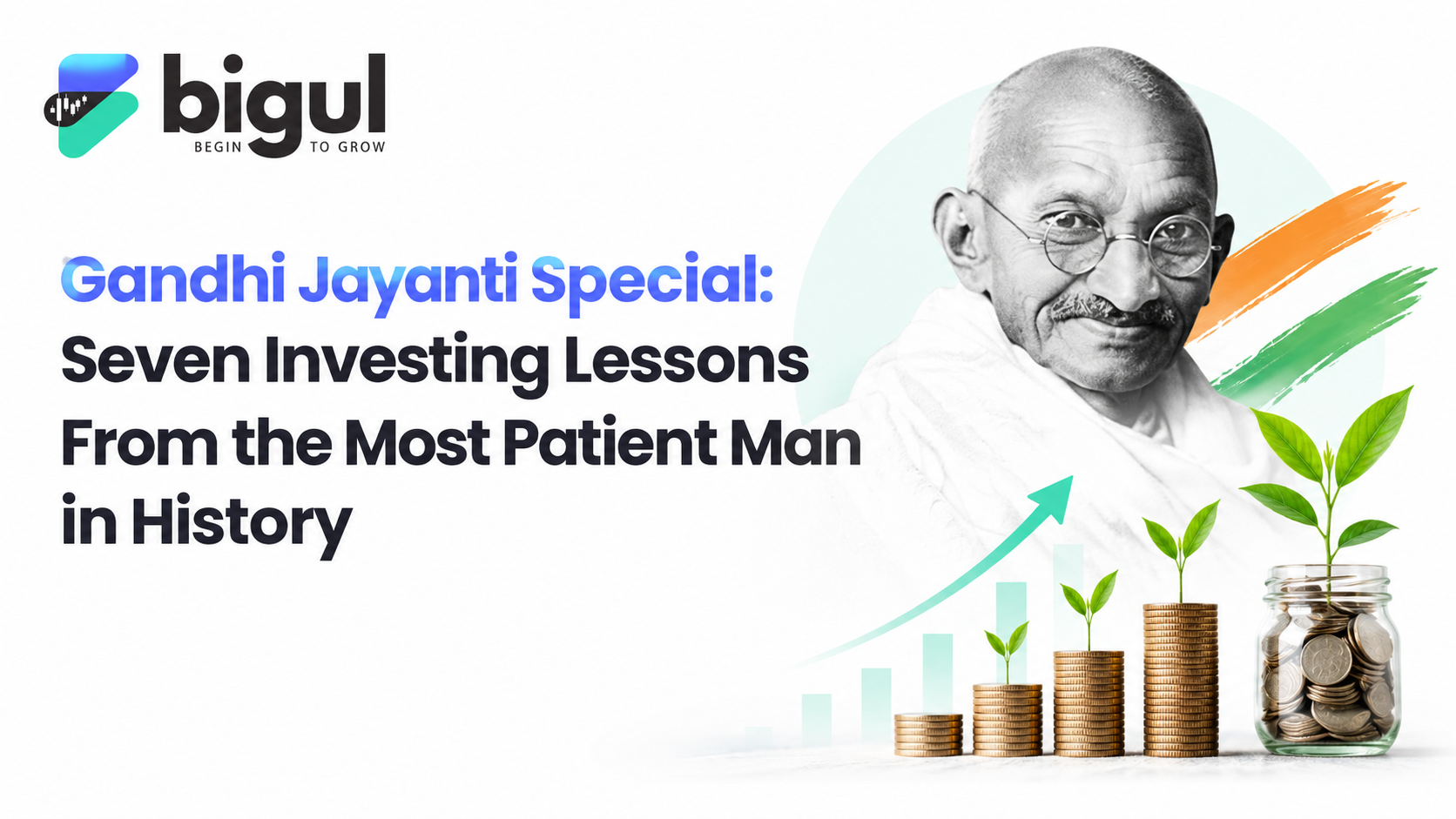
Seven Investing Lessons Inspired by Mahatma Gandhi on Gandhi Jayanti
Mahatma Gandhi never bought stock.
He owned almost nothing. His entire worldly possessions at the time of his death were a pair of glasses, sandals, a watch, fit into a small box.
And yet the principles that defined how he lived, how he led, and how he thought about change over time map onto the most important lessons in long-term investing with an accuracy that is genuinely surprising.
On Gandhi Jayanti, here are seven investing lessons from the man who understood patience, discipline, and the compounding of small consistent actions better than almost anyone in history.
1. Be the Change You Want to See in Your Portfolio
Gandhi didn’t wait for the world to change before he started living differently. He started with himself.
The most consistent reason investors underperform their own funds is behaviour exiting during corrections, chasing recent performance, pausing SIPs during uncertainty.
The fund or market cannot fix this.
Only the investor can.
The portfolio you want begins with the decisions you make when the market is testing you. Not with the fund you selected on a calm afternoon.
Be the investor you want your portfolio to reflect.
2. First They Ignore You, Then They Laugh at You, Then You Win
This quote often attributed to Gandhi describes the arc of almost every great long-term investment.
The early years of compounding feel ignored. The SIP that has been running for three years with modest visible growth. The position held through underperformance while others question the thesis.
Then the laughter or at least the doubt. The advisor who suggests switching. The family member who points to a fund that did better last year. The market narrative that makes staying invested feel naive.
Compounding builds quietly, invisibly, in the years that feel unremarkable and then accelerates in ways that make the patience look, in hindsight, like obvious wisdom.
Stay in the game long enough to get to the third act.
3. Strength Doesn’t Come From Winning. It Comes From Holding When You Are Losing.
Gandhi understood that the most important test of conviction is not what happens when things are going well.
The Nifty 50 has fallen 20% or more multiple times across its history. Every single correction felt, in the moment, like it might be different from the ones before it.
Every single one recovered.
The investors who captured the recovery were the ones who stayed invested when staying invested felt like the weakest possible response to what the market was doing.
Holding through a loss when the thesis is intact and the goal has not changed is not weakness.
It is the hardest form of discipline in investing.
4. The Future Depends on What You Do Today
Gandhi wasn’t talking about tomorrow. He was talking about the present action repeated consistently
as the only reliable path to a different future.
A ₹5,000 monthly SIP started today will build approximately ₹50 lakh in fifteen years at 12% per annum.
The same SIP started five years from now with the same discipline, the same fund, the same return
will build approximately ₹25 lakh in the same fifteen-year window.
The difference is not the amount or the fund.
It is the decision made today or not made today.
The future of your portfolio depends almost entirely on what you do right now.
Related Reading : How SIP works in Mutual funds : Calculation & Examples
5. Live Simply So Others May Simply Live,
Invest Simply So Your Returns May Simply Compound
Gandhi's approach to life was radical in its simplicity. Eliminate what is unnecessary. Focus entirely on what matters.
The same principle applied to investing produces remarkable results.
The investor with three well-chosen funds: matched to clear goals, held with discipline, reviewed annually will almost always outperform the investor with fifteen funds across twelve categories, each added for a different reason at a different market moment.
Complexity in a portfolio is rarely sophistication.
It is usually the accumulated result of too many decisions made for the wrong reasons.
Simplify. Define the goal. Choose the instrument.
The returns compound. The complexity does not add to them.
Related Guide : Step by Step Guide to Choosing Mutual funds for Beginners
6. A Small Body of Determined Spirits Can Change the Course of History
Gandhi built a movement not through grand gestures, but through consistent, daily, determined action by ordinary people.
The Indian retail investor has done something remarkably similar to India's equity markets.
SIP inflows crossed ₹31,961 crore in July 2026. 10.63 crore active SIP accounts. Domestic institutional investors owned more of India's listed market than foreign investors for seven consecutive quarters.
Individual investors each contributing ₹500 to ₹5,000 per month have collectively absorbed record foreign institutional selling, stabilised markets during global volatility, and built household equity wealth of ₹90.3 lakh crore since March 2020.
Small. Consistent. Determined.
Exactly what Gandhi understood about how meaningful change actually happens.
7. You May Never Know What Results Come from Your Actions.
But If You Do Nothing, There Will Be No Results.
This is the most important investing lesson of all.
The investor waiting for perfect market conditions. The professional who will start the SIP next month. The person who wants to understand investing better before putting any money to work.
Perfect conditions never arrive.
The cost of waiting is not zero. It is the compounding that did not happen, the years that cannot be recovered, the curve that only bends if the investment was made early enough to be on it.
The Bottom Line
Gandhi never invested in markets.
But the principles he lived by; patience, simplicity, consistency, discipline, the willingness to hold through difficulty, and the conviction that small daily actions compound into something remarkable are the exact principles that separate investors who build real wealth from the ones who spend their lives waiting for the right moment.
On Gandhi Jayanti, the best financial decision you can make is the one you have been deferring.
Start the SIP. Review the portfolio. Define the goal.
Explore More : How to Start an SIP with ₹100–₹500 in India