



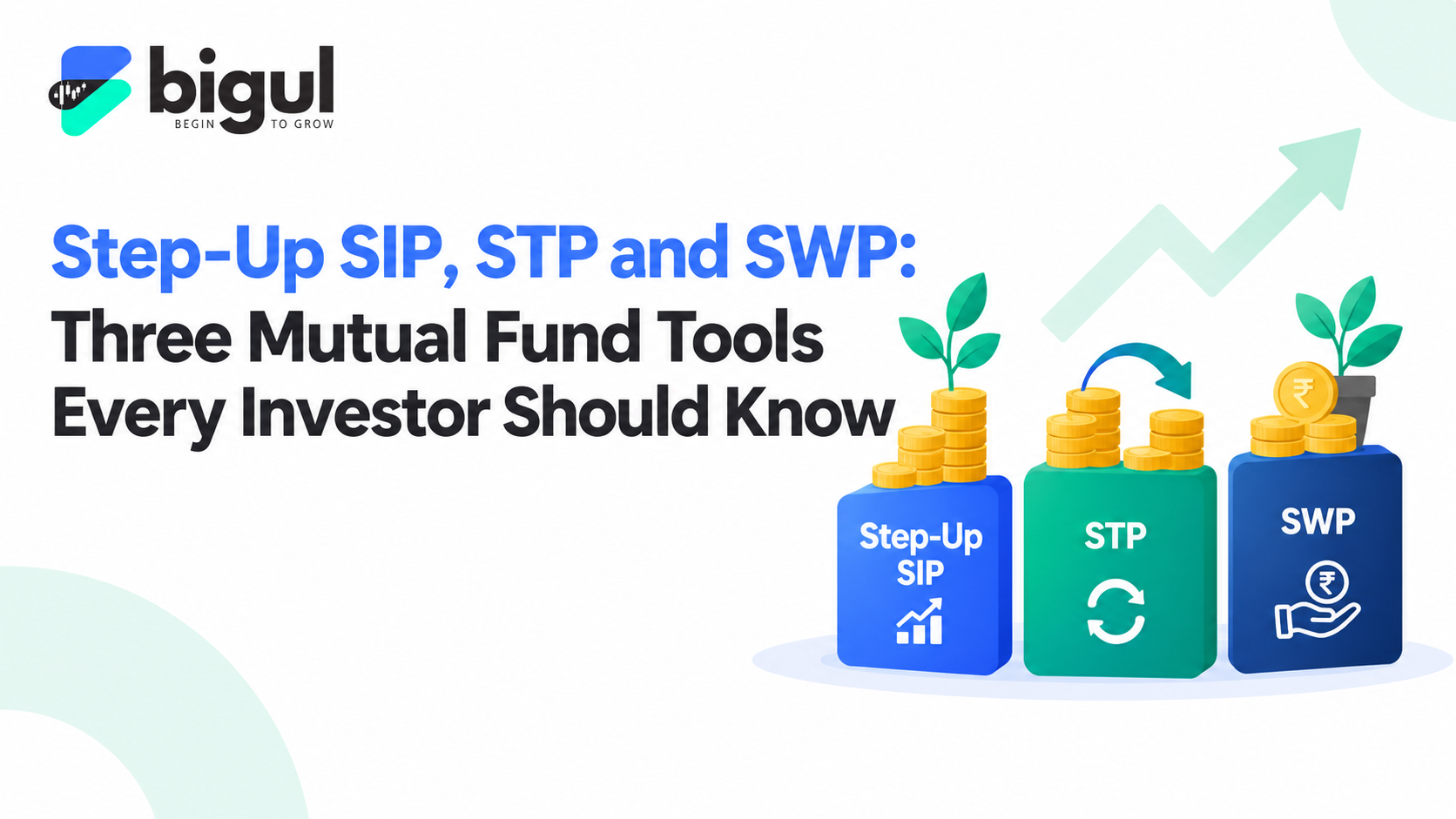
Step-Up SIP, STP and SWP: Three Mutual Fund Tools Every Investor Should Know
 25-Sep-2026
 2 mins read
Trending Now
-

Turtlemint Fintech Solutions IPO GMP, Open Date, Price Band, Issue Size 18-Jun-2026
-
.jpg)
SpaceX IPO: Elon Musk Becomes World's First Trillionaire — Key Facts Explained 13-Jun-2026
-

Zepto IPO, Open Date, Issue Size, Price Band and UDRHP Filed 12-Jun-2026
-
Shah Metacorp Rights Issue May 2026 Details, Record Date, Issue Price 26-May-2026
-

Jio Is Going Public. Here's What That Actually Means for You 11-May-2026
-

Parle Products IPO: India’s Most Iconic Biscuit Brand Going Public? 30-Apr-2026
-
Gujarat Cotex Rights Issue 2026 Details, Record Date, Issue Price 27-Mar-2026
-
.jpg)
Avi Polymers Rights Issue 2026 Details, Record Date, Issue Price 11-Feb-2026
-

D & H India Rights Issue 2026 Details, Record Date, Issue Price 05-Feb-2026
-

Avasara Finance Rights Issue 2025 Details, Record Date, Issue Price 29-Dec-2025

Step-Up SIP, STP and SWP: Three Mutual Fund Tools Every Investor Should Know
Most investors know what a SIP is.
Start a monthly investment. Let it run. Watch it compound over time.
But the mutual fund ecosystem has three more powerful tools:
Step-Up SIP. STP. SWP.
Each solves a specific problem and are more useful than most investors realise.
Here is a clear breakdown of all three.
Step-Up SIP: Grow Your Investment as Your Income Grows
A regular SIP invests the same fixed amount every month.
A Step-Up SIP also called a Top-Up SIP automatically increases your monthly investment amount by a fixed percentage or fixed amount at a defined interval. Typically annually.
How it works:
You start a SIP of ₹5,000 per month. You set a 10% annual step-up. Every year — automatically, without any action on your part, the SIP amount increases by 10%.
Year 1 — ₹5,000 per month
Year 2 — ₹5,500 per month
And so on.
Why it matters.
A ₹5,000 monthly SIP at 12% per annum over 20 years builds approximately ₹49.5 lakh.
The same SIP with a 10% annual step-up builds approximately ₹1.01 crore over the same period.
Same fund. Same market return. More than double the outcome, simply by increasing the investment in line with income growth.
Most people earn more every year. Their lifestyle expands to absorb the increment. A Step-Up SIP ensures that a portion of every income increase goes directly into wealth creation automatically, before the lifestyle decision can override it.
Best suited for: Salaried investors who receive annual increments and want wealth creation to keep pace with income growth.
STP: Systematic Transfer Plan — The Smart Way to Move a Lump Sum into Equity
Suppose you receive ₹5 lakh — a bonus or a property sale proceeds and want to invest it in equity mutual funds.
Putting the entire amount into equity in one shot exposes you to timing risk. If markets fall immediately after your lump sum investment, the loss is significant.
An STP solves this.
How it works:
You invest the ₹5 lakh into a liquid or debt mutual fund which is low risk and earns a modest return while your money waits. You then set up a SWP to automatically move a fixed amount,
say ₹50,000 per month from the liquid fund into your chosen equity fund.
Over ten months your ₹5 lakh gradually moves from low-risk to equity at different NAV levels across different months.
If markets fall during those ten months, you buy more units at lower prices. If markets rise, you buy fewer units at higher prices. The averaging effect reduces the risk of entering equity at a single price point.
Your lump sum earns a return while it waits in the liquid fund. And it enters equity gradually rather than all at once.
Best suited for: Investors with a lump sum who want equity exposure but are nervous about market timing.
SWP: Systematic Withdrawal Plan — Your Personal Pension
A SWP is the mirror image of a SIP.
Instead of putting money in every month; a SWP takes money out every month.
How it works:
You have accumulated ₹50 lakh in a mutual fund over your working years. You retire. You need ₹25,000 every month to cover expenses.
You set up a SWP and every month, ₹25,000 is automatically redeemed from your fund and credited to your bank account.
The remaining corpus ₹49.75 lakh after the first withdrawal, adjusted for market movement continues to earn returns in the fund.
If the fund earns more than you withdraw; the corpus grows even as you draw from it.
The tax advantage:
This is where SWP becomes powerful for long-term investors.
Each monthly withdrawal is treated as a partial redemption. The gains portion of each redemption is taxed, the return of original capital is not. For long-term equity holdings only the gains above ₹1.25 lakh per year attract LTCG at 12.5%.
Compare this to a fixed deposit where the entire interest income is taxed at your applicable slab rate every year.
For investors in higher tax brackets; a SWP from an equity or balanced fund can be significantly more tax-efficient than fixed deposits as a source of regular income.
Best suited for: Retirees or investors who need regular monthly income from an accumulated corpus. Also useful for anyone funding a recurring expense — EMIs, school fees, rent from investments.
How the Three Work Together
Accumulation phase — Use a Step-Up SIP to build your corpus over your working years. Starting small and increasing annually keeps wealth creation aligned with income growth.
Transition phase — Use an STP when you receive a lump sum — inheritance, business exit, maturity amount — to move it into equity gradually without timing risk.
Distribution phase — Use a SWP to convert your accumulated corpus into a steady monthly income stream — in a tax-efficient way — during retirement or any period of reduced income.
Quick Comparison Table
|
Tool |
What It Does |
Best Used For |
|
Step-Up SIP |
Automatically increases SIP amount annually |
Building wealth aligned with income growth |
|
STP |
Moves lump sum from debt to equity gradually |
Investing a lump sum without timing risk |
|
SWP |
Withdraws a fixed amount monthly from a fund |
Regular income from accumulated corpus |
FAQs
Can I set up a Step-Up SIP on any mutual fund?
Most fund houses and platforms offer Step-Up SIP as an option when setting up a new SIP. Check whether your platform supports it before starting.
What is the minimum amount for an STP?
Minimum STP amounts vary by fund house — typically ₹500 to ₹1,000 per transfer. The source fund usually requires a minimum investment of ₹5,000 to ₹10,000 to initiate an STP.
How is SWP taxed?
Each withdrawal is treated as a partial redemption. For equity funds — gains held over 12 months attract LTCG at 12.5% above ₹1.25 lakh per year. Gains held under 12 months attract STCG at 20%. The return of original capital is not taxed.
Start Your Mutual Fund Journey with Bigul