



ETF vs Mutual Fund: What's the Difference?
 03-Sep-2026
 2 mins read
Trending Now
-

Turtlemint Fintech Solutions IPO GMP, Open Date, Price Band, Issue Size 18-Jun-2026
-
.jpg)
SpaceX IPO: Elon Musk Becomes World's First Trillionaire — Key Facts Explained 13-Jun-2026
-

Zepto IPO, Open Date, Issue Size, Price Band and UDRHP Filed 12-Jun-2026
-
Shah Metacorp Rights Issue May 2026 Details, Record Date, Issue Price 26-May-2026
-

Jio Is Going Public. Here's What That Actually Means for You 11-May-2026
-

Parle Products IPO: India’s Most Iconic Biscuit Brand Going Public? 30-Apr-2026
-
Gujarat Cotex Rights Issue 2026 Details, Record Date, Issue Price 27-Mar-2026
-
.jpg)
Avi Polymers Rights Issue 2026 Details, Record Date, Issue Price 11-Feb-2026
-

D & H India Rights Issue 2026 Details, Record Date, Issue Price 05-Feb-2026
-

Avasara Finance Rights Issue 2025 Details, Record Date, Issue Price 29-Dec-2025

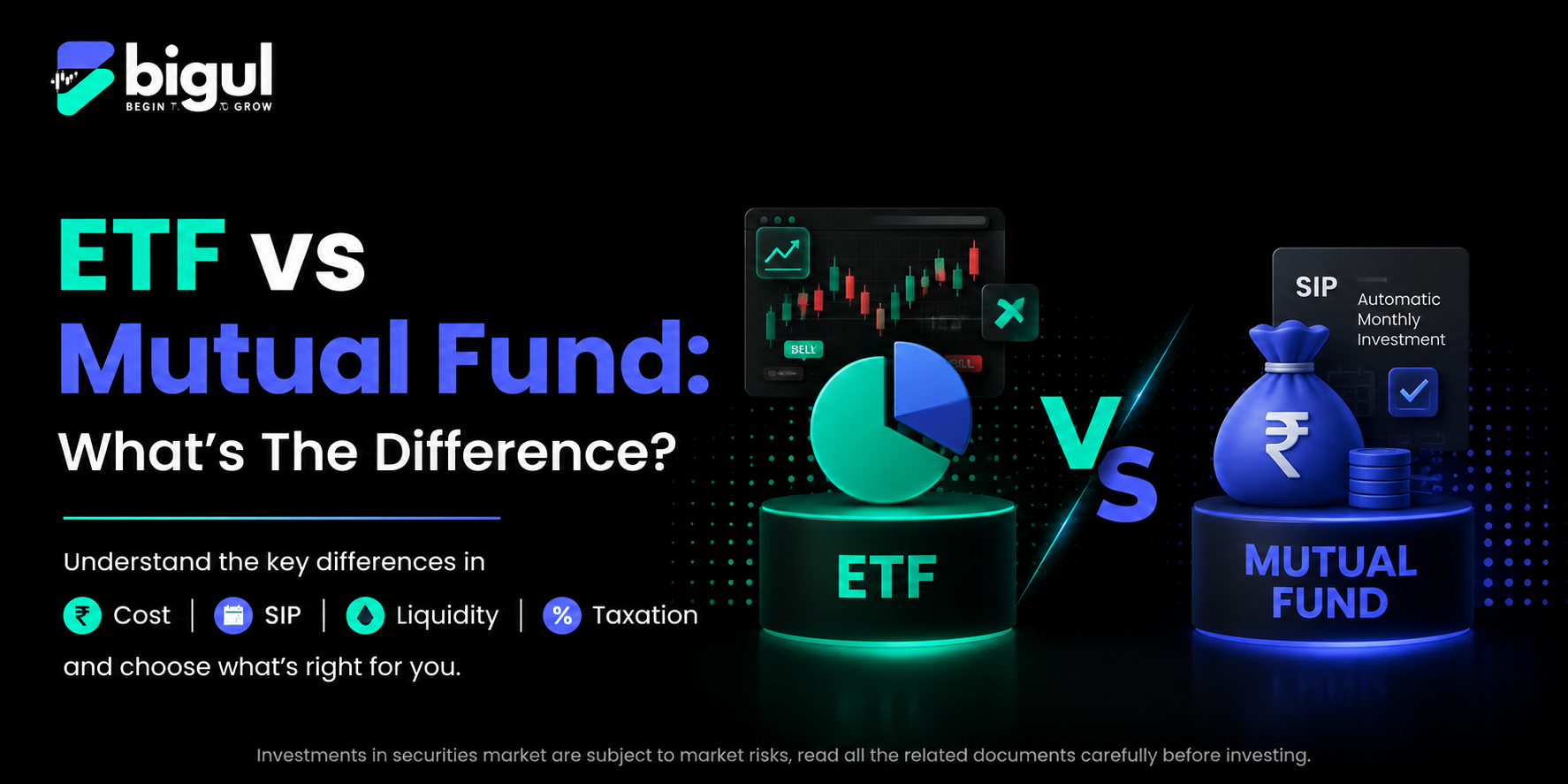
ETF vs Mutual Fund: Understand the key differences in cost, SIP, liquidity, taxation, and investment flexibility.
An ETF and a mutual fund walk into the same market.
They buy the same stocks. They follow the same index. They are regulated by the same regulator.
And yet one costs significantly less, one is easier to invest in monthly, and one requires something the other does not.
The difference matters more than most investors realise.
What Is a Mutual Fund?
A mutual fund pools money from multiple investors and invests it in a portfolio of stocks, bonds, or other assets, managed by a professional fund manager.
You buy units at the Net Asset Value (NAV), the price calculated at the end of each trading day. All transactions happen at day-end NAV. No buying or selling at live prices during market hours.
Most mutual funds in India are actively managed; a fund manager decides which stocks to buy, hold, or sell with the goal of outperforming a benchmark.
Minimum investment: ₹500 per month through SIP. No demat account required.
What Is an ETF?
An ETF (Exchange Traded Fund) tracks an index like the Nifty 50 or Sensex and trades on NSE & BSE like a regular share.
You buy and sell ETF units at live market prices throughout the day. Most ETFs are passively managed, they replicate the index rather than trying to beat it.
Minimum investment: Price of one unit as low as ₹50 for some ETFs. A demat account is required.
The Key Differences
|
Factor |
ETF |
Mutual Fund |
|
How it trades |
Live prices during market hours |
At end-of-day NAV only |
|
Management style |
Mostly passive |
Active or passive |
|
Expense ratio |
0.05% to 0.20% |
0.5% to 1.5% for active funds |
|
SIP |
Must buy manually |
Automatic monthly investment |
|
Liquidity |
Sell any time during market hours |
T+1 to T+3 redemption |
|
Minimum investment |
Price of one unit |
₹500 per month for SIP |
The Cost Difference And Why It Matters
ETF expense ratios in India are typically between 0.05% and 0.20% per year. Actively managed mutual funds charge between 0.5% and 1.5%.
That sounds small. Over twenty years, it is not.
₹10 lakh invested growing at 12% per year:
-
At 0.10% (ETF) - approximately ₹94.8 lakh after 20 years
-
At 1.5% (active mutual fund) - approximately ₹73.7 lakh after 20 years
That is a difference of approximately ₹21 lakh from fees alone. The market gave the same return. Costs just ate into one more than the other.
This does not mean mutual funds are wrong. Active funds can and do outperform their benchmarks, some consistently. But it is worth understanding what you are paying for and whether the active management is delivering enough additional return to justify the higher cost.
Liquidity — A Practical Difference
ETFs trade throughout the day. If markets move sharply and you want to act, you can. You can also place limit orders, stop-loss orders, and buy during intraday dips.
Mutual funds process redemptions once per day at the closing NAV. If you submit a redemption request before the cutoff, you get that day's NAV. After the cutoff you get the next day's NAV.
For most long-term investors, this difference does not matter much. For investors who want more control over timing, ETFs offer flexibility that mutual funds cannot.
SIP — The Mutual Fund Advantage
For systematic monthly investing, mutual funds have a clear practical advantage.
SIPs automate the investment process. A fixed amount is deducted from your bank account every month and invested in the fund automatically. No action required.
ETFs do not have a direct SIP mechanism. You must manually buy units each month which requires logging in, placing an order, and managing the process yourself.
For investors building long-term wealth through consistent monthly contributions, the SIP automation that mutual funds offer is a significant practical benefit that ETFs currently cannot match.
Taxation — Same for Both
Both ETFs and actively managed equity mutual funds have the same tax treatment in India for FY 2026-27:
-
Held for more than 12 months: LTCG at 12.5% on gains above ₹1.25 lakh
-
Held for less than 12 months: STCG at 20%
There is no tax advantage for one over the other from a capital gains perspective. Both are treated identically under current Indian tax law.
Which Should You Choose?
Choose an ETF if:
-
You want the lowest possible cost for index exposure
-
You have a demat account and are comfortable buying units manually
-
You want intraday flexibility, the ability to buy & sell at live prices
-
You are investing a lump sum rather than monthly contributions
Choose a mutual fund if:
-
You want to invest through automatic monthly SIPs
-
You prefer active management and are willing to pay for it
-
You do not have a demat account or prefer not to open one
-
You are a first-time investor who values simplicity and automation
For most retail investors in India, the combination works well.
Index mutual funds or ETFs for low-cost passive exposure. Actively managed mutual funds through SIPs for goal-based long-term wealth creation.
FAQs
Are ETFs better than mutual funds in India?
Neither is universally better. ETFs offer lower costs and intraday flexibility. Mutual funds offer SIP automation and active management. The right choice depends on your investment style, goals, and whether you have a demat account.
Do I need a demat account to invest in ETFs?
Yes. ETFs are traded on stock exchanges and require a demat and trading account. Regular and direct mutual fund plans do not require a demat account.
Can I do SIP in ETFs?
Not directly. Some brokers offer automated monthly ETF purchase features — but this is not the same as a traditional mutual fund SIP. Most investors do SIPs through mutual funds for this reason.
Is the tax on ETFs and mutual funds the same?
Yes. Both equity ETFs and equity mutual funds are taxed identically — LTCG at 12.5% above ₹1.25 lakh for holdings over 12 months, STCG at 20% for holdings under 12 months.
Also Read :- scheme information document