



Taiwan Has TSMC. South Korea Has Samsung. What Does India Have?
 13-Oct-2026
 2 mins read
Trending Now
-

Turtlemint Fintech Solutions IPO GMP, Open Date, Price Band, Issue Size 18-Jun-2026
-
.jpg)
SpaceX IPO: Elon Musk Becomes World's First Trillionaire — Key Facts Explained 13-Jun-2026
-

Zepto IPO, Open Date, Issue Size, Price Band and UDRHP Filed 12-Jun-2026
-

Shah Metacorp Rights Issue May 2026 Details, Record Date, Issue Price 26-May-2026
-

Jio Is Going Public. Here's What That Actually Means for You 11-May-2026
-

Parle Products IPO: India’s Most Iconic Biscuit Brand Going Public? 30-Apr-2026
-
Gujarat Cotex Rights Issue 2026 Details, Record Date, Issue Price 27-Mar-2026
-
.jpg)
Avi Polymers Rights Issue 2026 Details, Record Date, Issue Price 11-Feb-2026
-

D & H India Rights Issue 2026 Details, Record Date, Issue Price 05-Feb-2026
-

Avasara Finance Rights Issue 2025 Details, Record Date, Issue Price 29-Dec-2025

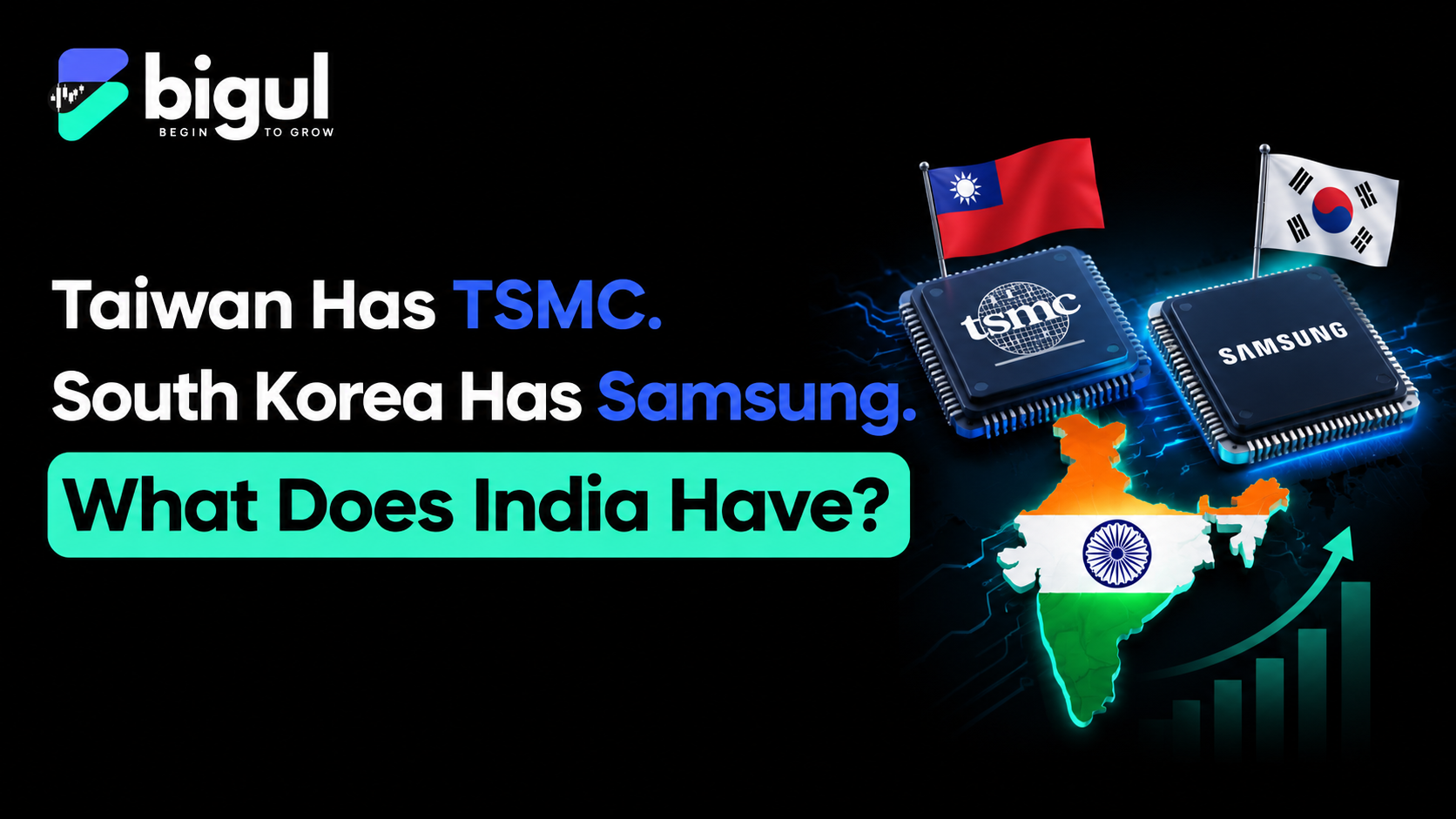
Global AI hardware investments, foreign investor outflows, and domestic SIP contributions are reshaping India's stock market landscape.
Every time you type a prompt into AI, something physical makes that response possible.
Thousands of specialised chips processing your request. Advanced cooling systems keep everything from melting. The entire infrastructure of modern AI runs on physical components and the companies building those components are minting money at a pace the world has rarely seen.
TSMC, the Taiwanese company that manufactures the world's most advanced chips, reported revenue up 54.6% in September 2026 compared to a year earlier. Its nine-month revenue for 2026 is up 41.1% year on year. Samsung and SK Hynix make the memory chips AI data centres consume by the tonne.
Meta, Alphabet, Amazon, and Microsoft together plan to spend over $400 billion building AI systems next year, a 21% jump from 2025. Every dollar of that spending eventually reaches TSMC, Samsung, and SK Hynix.
India’s biggest listed companies are in banking, consumer goods, and IT services.
The gap between where global AI spending flows and where India sits is the story behind the numbers.
The Numbers Tell the Story
Foreign investors bought ₹20,200 crore of Indian shares in July 2026. Then ₹29,631 crore in August. It looked like the selling was finally over.
Then September arrived and they sold ₹35,861 crore. By October 11 another ₹44,166 crore was gone. Total FII outflows in 2026 crossed ₹3.04 lakh crore. Nearly double the entire outflow of ₹1.66 lakh crore across all of 2025.
The MSCI Emerging Markets Index tells the same story from a different angle.
Think of it as the world’s most important emerging market shopping basket used by global funds to decide where money goes. India accounted for roughly 19% in mid-2024. By September 30 2026 — 10.65%.
And for the first time in 26 years, not a single Indian company appears in the MSCI EM top 10.
Where Does India Fit in the AI Story?
India is not absent from AI. It is just not on the hardware side of it.
India's strength is in software, services, and increasingly using AI rather than building the physical infrastructure it runs on.
TCS reported in October that its annualised AI revenue had reached $3.1 billion, more than 10% of total revenue. But overall revenue grew just 0.5% quarter on quarter in constant currency.
AI is bringing in new business for Indian IT. But the same AI that generates new revenue is also automating some of the work that generates existing revenue. The net effect on growth has been slower than the AI revenue headline suggests.
India is also building a semiconductor industry, 12 projects approved across six states, three facilities already in commercial production. But TSMC took 35 years to become what it is today. These things do not happen in one budget cycle.
But Here Is What the Headline Misses
In July 2026, while India received $2.12 billion in foreign inflows, global investors were pulling $22.95 billion out of Taiwan and $6.26 billion out of South Korea.
The markets supposedly winning the AI capital race were being sold harder than India.
In September, foreign investors sold $23.49 billion across seven Asian markets. South Korea alone accounted for more than 70%.
Even AI's biggest beneficiaries are not immune when global investors get nervous.
Crude oil above $100 per barrel squeezes India's import bill and weakens the rupee. US yields above 5% offer a safe return that makes Indian equity risk feel less compelling. Indian valuations — even after a 14% correction remain elevated.
AI rotation is just one part of the story.
Who Is Actually Holding India’s Market Together?
Here is what gets buried under the outflow headlines.
FII ownership of Indian equities has fallen to approximately 16%, the lowest level in nearly two decades. And for the first time ever, it is lower than domestic institutional ownership.
DII ownership has hit a record high.
Equity mutual funds received ₹38,307 crore in September alone. Monthly SIP contributions reached a record ₹32,490 crore. Domestic institutions absorbed approximately 90% of the FII selling.
Crore of Indian investors each contributing ₹500 or ₹5,000 into a SIP every month collectively became the primary source of stability in a market facing record foreign outflows.
Foreign investors have not given up on India entirely either. They invested $9.2 billion in new Indian share offerings over the 12 months to September 2026 even as they withdrew $39 billion from listed shares. They are being selective.
Related Reading : FII vs DII How it impact stock market
So What Does This Mean for You?
If you are a long-term Indian investor, the FII outflow headline is real but not the whole picture.
GDP growing at 7.8%. A domestic consumer market of 140 crore people. Companies with strong fundamentals and long-term earnings potential.
What changed is the global competition for capital. The AI hardware boom made Taiwan and South Korea more interesting to global investors in the short term. India’s response; semiconductor capacity,
AI applications, domestic institutional depth is the right direction. It just takes time.
The SIP running automatically every month does not ask whether global investors prefer TSMC today. It just keeps building the corpus.
That consistency multiplied across crore of investors is what has kept India's market standing through the largest foreign outflow in its history.
Foreign investors will return when the risk-reward calculation shifts back in India's favour.
The domestic foundation keeping the market standing while they are away, that is the story worth paying attention to.
Related Guide : CAGR VS XIRR : How to calculate returns
FAQs
Why are foreign investors selling Indian stocks?
Four things simultaneously: Crude above $100 weakening the rupee, US yields above 5%, elevated Indian valuations, and capital rotating toward AI hardware markets in Taiwan and South Korea.
Is AI directly causing FII outflows from India?
Partly. But oil, dollar strength, and US yields are equally responsible. The selling in Taiwan and South Korea in July shows even AI markets are not immune to global risk-off.
Will foreign investors come back?
When conditions shift, lower crude, stabilising rupee, US yields softening, Indian earnings growing into valuations. No fixed date. Just conditions.
Explore : Invest in Mutual Funds today with Bigul