



Diamonds Are Forever. Their Prices Are Not.
 22-Oct-2026
 2 mins read
Trending Now
-

Turtlemint Fintech Solutions IPO GMP, Open Date, Price Band, Issue Size 18-Jun-2026
-
.jpg)
SpaceX IPO: Elon Musk Becomes World's First Trillionaire — Key Facts Explained 13-Jun-2026
-

Zepto IPO, Open Date, Issue Size, Price Band and UDRHP Filed 12-Jun-2026
-

Shah Metacorp Rights Issue May 2026 Details, Record Date, Issue Price 26-May-2026
-

Jio Is Going Public. Here's What That Actually Means for You 11-May-2026
-

Parle Products IPO: India’s Most Iconic Biscuit Brand Going Public? 30-Apr-2026
-
Gujarat Cotex Rights Issue 2026 Details, Record Date, Issue Price 27-Mar-2026
-
.jpg)
Avi Polymers Rights Issue 2026 Details, Record Date, Issue Price 11-Feb-2026
-

D & H India Rights Issue 2026 Details, Record Date, Issue Price 05-Feb-2026
-

Avasara Finance Rights Issue 2025 Details, Record Date, Issue Price 29-Dec-2025

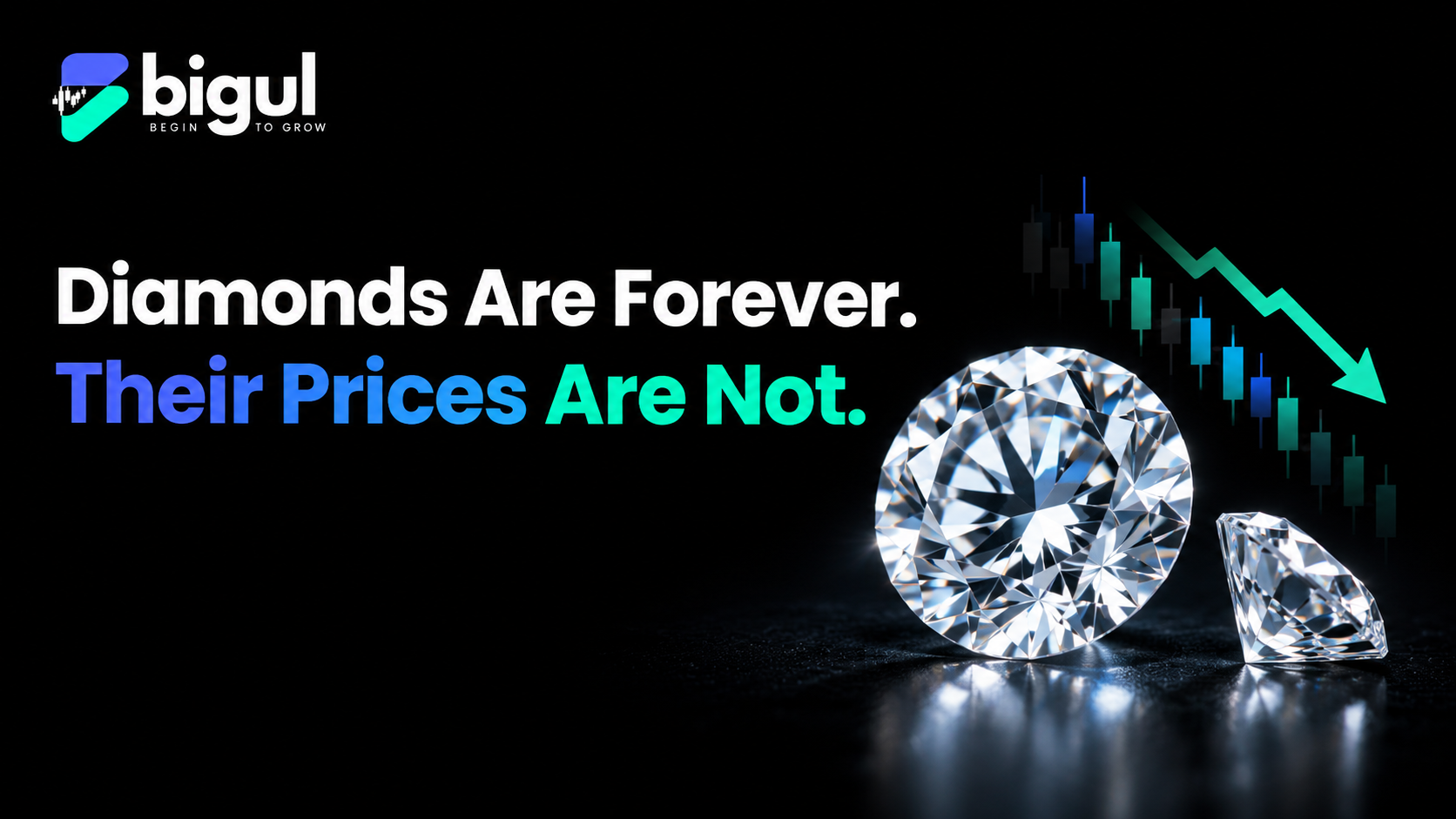
Falling natural diamond prices and cheaper lab-grown alternatives are reshaping India's diamond industry and challenging the idea of diamonds as investments.
In 1938, a young diamond industry executive named Harry Oppenheimer had a problem.
Diamonds were everywhere. New mines in South Africa had flooded the market. Prices were falling. The stone that was supposed to symbolise wealth and rarity was becoming ordinary.
So Oppenheimer did something extraordinary.
He did not fix the supply problem. He manufactured a new human desire.
He hired an advertising agency and gave them a simple brief. Make diamonds emotionally irreplaceable. Make selling them feel like a betrayal.
The result, launched in 1947 was four of the most consequential words in marketing history.
A Diamond is Forever.
If diamonds are forever, you never sell them. And if nobody sells them, no one discovers how little
they are worth on resale. The secondary market never develops. The price illusion holds.
For eighty years, it worked.
And then exactly on the timeline Oppenheimer’s successors feared, it stopped.
What Is Actually Happening to Diamond Prices
Rough diamond valuations have fallen approximately 37% between 2024 and the first half of 2026,
a decline severe enough to challenge one of the oldest assumptions in luxury.
In India, diamond prices reached $3,257 per carat in June 2026 down from $3,475 per carat just a year earlier. The Natural Diamond Index declined 3.6% in Q1 2026 but that average masks far sharper falls in smaller stones.
The real pain is in smaller, lower-quality diamonds. The kind that fills most engagement rings. The kind that most Indian families buy for weddings.
And the reason, when you trace it back, is technological.
The Machine That Broke the Myth
In a laboratory in China or India today, a technician is growing a diamond.
Not simulating one. Growing an actual diamond, identical crystal structure, identical physical properties, indistinguishable to the naked eye in weeks rather than billions of years.
Lab-grown diamond prices have cratered 74% since 2020. Wholesale prices now sit around $50 per carat, nearly 20 times cheaper than natural diamonds. The average lab-grown discount to natural diamonds widened from 26.6% in 2019 to 88.1% by July 2026.
A product chemically, physically and optically identical to a natural diamond, selling for 88% less.
For decades, the diamond industry’s answer was emotional. Natural diamonds are rare. They come from the earth. They have a story.
That argument is increasingly difficult to make to a 28-year-old buying an engagement ring who can get the same stone for one-tenth the price.
What This Means for Surat and India
There is a city in Gujarat where approximately 80% of the world’s diamonds are cut and polished.
Surat.
At its peak, the Surat diamond industry employed over one million workers. Entire neighbourhoods built their livelihoods around transforming rough stones from South African and Russian mines into the gems that end up in jewellery stores worldwide.
India’s cut and polished diamond exports fell 6.96% to $5.81 billion during April to September 2026. For the full year FY2025-26 exports fell to $12.16 billion, their lowest level in more than two decades. Operating margins compressed by roughly 400 basis points to approximately 4%.
The workers of Surat did not cause the diamond industry’s problems. They are the most skilled cutters and polishers in the world, a craft refined over generations.
The crisis facing them is not about quality or capability.
It is about the raw material they depend on losing its economic rationale.
Lab-Grown — Is That the Answer?
Lab-grown diamonds are disrupting natural diamonds. But they are also disrupting themselves.
India’s polished lab-grown diamond exports surged 17.08% to $685.10 million during April to September 2026. That growth sounds exciting. But the margins tell a different story.
Lab-grown prices have fallen so far, so fast that the business of making them is becoming nearly as difficult as the business of cutting natural ones. When a product falls 74% in four years, the question is not just who is winning the market. It is whether there is a viable market left to win.
The Investment Illusion
Diamonds were never an investment.
Not in the way stocks, bonds, real estate, or gold are investments.
A genuine investment generates a return. It can be bought and sold at a transparent market price. It has a clear mechanism for value creation.
Diamonds have none of these.
They pay no dividend. They generate no cash flow. Buy a diamond from a jeweller and try to sell it back three months later, you will receive approximately 20 to 40 cents on the dollar.
This is not a market inefficiency. It is a feature designed by De Beers over a century to ensure diamonds flow in one direction only. From mines to consumers. Never back.
The “A Diamond is Forever” campaign was not just marketing. It was economic engineering. By making selling a diamond emotionally unacceptable, it prevented a liquid secondary market from ever developing.
Lab-grown diamonds did something unintentional but important. By making the same product available at 88% lower prices, they made the gap between purchase price and resale value impossible to ignore.
The myth is not dead. But it is significantly less convincing than it was five years ago.
Related Reading : compare Gold ETFs, Sovereign Gold Bonds and physical gold
What Comes Next
The picture for natural diamonds is not entirely bleak.
Primary natural diamond production is expected to decline approximately 1% annually over the next decade, driven by ageing mines and a scarcity of new discoveries. Declining supply could support prices for larger, higher-quality stones. Natural diamond prices in India are expected to achieve some stability with stones above 1.2 carats showing the most resilience.
Whether it holds in a world where a machine can grow a chemically identical diamond in three weeks
is the central question of the next decade.
Related Guide : ETF vs mutual fund: which is better?
FAQs
Why are natural diamond prices falling so sharply?
Three forces converging simultaneously; weak demand in China, competition from lab-grown diamonds that are now 88% cheaper than natural equivalents, and elevated inventories throughout the supply chain.
Are diamonds a good investment?
Diamonds have no transparent secondary market, generate no income, and lose significant value on resale. The “diamond as investment” idea was a marketing construct designed to prevent resale and maintain price illusions.
Explore : where your gold investments are stored