



AI Trading vs Algo Trading: What Is the Difference and Which One Is Right for You?
 24-Sep-2026
 2 mins read
Trending Now
-

Turtlemint Fintech Solutions IPO GMP, Open Date, Price Band, Issue Size 18-Jun-2026
-
.jpg)
SpaceX IPO: Elon Musk Becomes World's First Trillionaire — Key Facts Explained 13-Jun-2026
-

Zepto IPO, Open Date, Issue Size, Price Band and UDRHP Filed 12-Jun-2026
-
Shah Metacorp Rights Issue May 2026 Details, Record Date, Issue Price 26-May-2026
-

Jio Is Going Public. Here's What That Actually Means for You 11-May-2026
-

Parle Products IPO: India’s Most Iconic Biscuit Brand Going Public? 30-Apr-2026
-
Gujarat Cotex Rights Issue 2026 Details, Record Date, Issue Price 27-Mar-2026
-
.jpg)
Avi Polymers Rights Issue 2026 Details, Record Date, Issue Price 11-Feb-2026
-

D & H India Rights Issue 2026 Details, Record Date, Issue Price 05-Feb-2026
-

Avasara Finance Rights Issue 2025 Details, Record Date, Issue Price 29-Dec-2025

AI Trading vs Algo Trading: Understanding the Key Differences
Everyone is talking about AI trading and algo trading.
Half the trading platforms in India are marketing one or the other as the future of retail investing. Telegram groups are full of "AI-powered signals." Brokers are advertising algo strategies.
Fintech startups are promising automated returns.
And most retail traders have no idea what any of it actually means.
Here is the clear version of what AI trading and algo trading actually are, how they differ, and what the SEBI framework that became mandatory on April 1 2026 means for you as a retail trader.
Two Approaches. One Clear Difference.
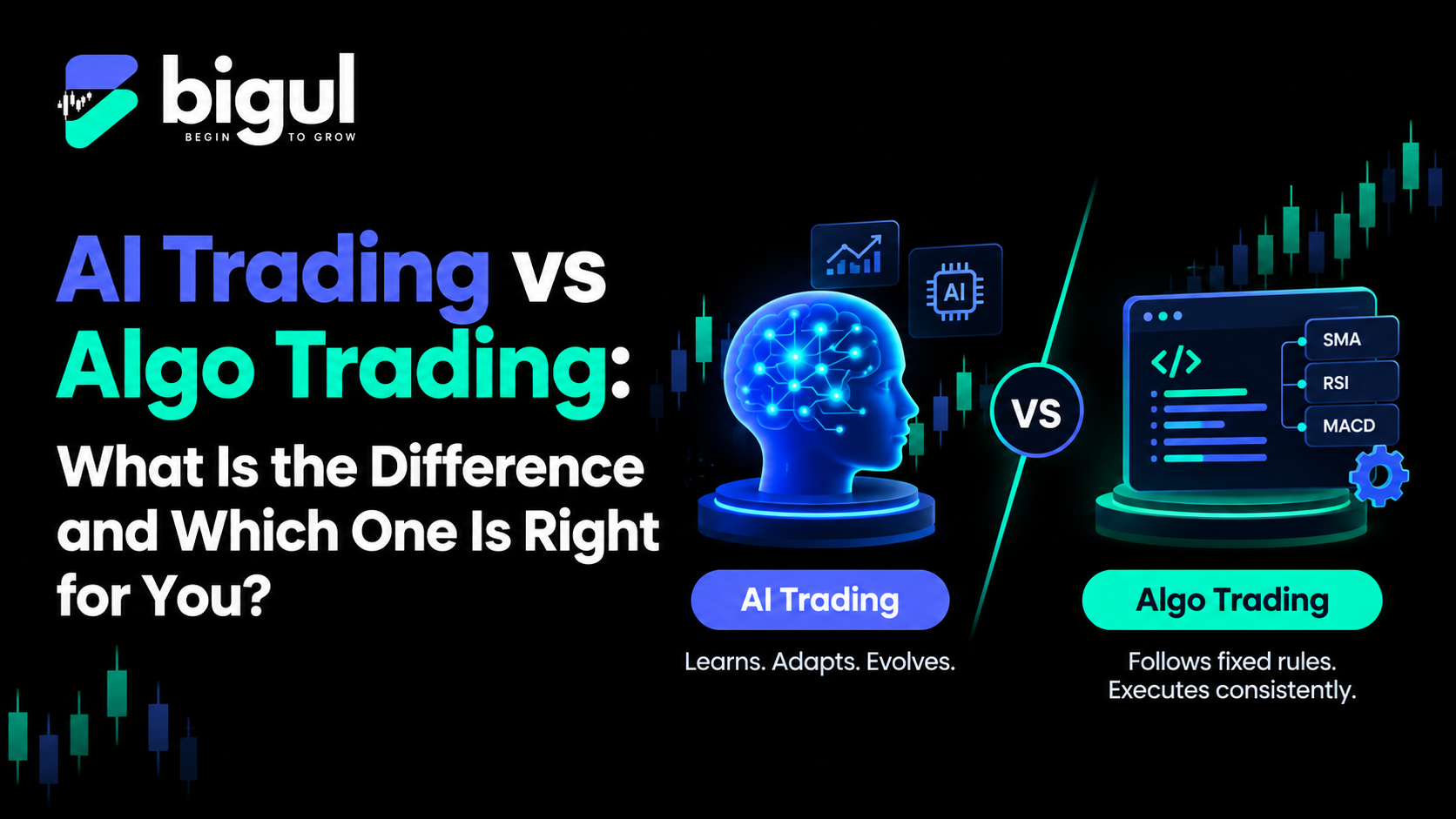
Algo trading is a recipe.
You write the rules. Buy when the 50-day moving average crosses the 200-day moving average. Sell when RSI crosses 70. Exit if the position is down 2%. The system follows those rules exactly every time, without emotion, without hesitation, without the second-guessing that costs most manual traders their edge.
The rules are fixed. The system executes them.
AI trading is a chef who learns.
Instead of following a fixed recipe; an AI trading system reads data, identifies patterns, and figures out the rules by itself. Nobody writes "buy when RSI crosses 30." The model is shown thousands of examples of what happened before and after various market conditions and learns to identify what matters.
The key difference: algo trading runs the same rules every time. AI trading adapts as it sees more data.
Both can place trades automatically. Both can remove emotion from execution. But how they arrive at the decision to trade is fundamentally different.
How They Work in Practice
Algo Trading — Rule-Based Execution
A trader builds a strategy. Backtest it against historical data. If it holds up, the strategy gets coded and connected to a broker API. From that point every time the market conditions match the defined rules, the system places the order automatically.
No screen watching, manual clicking or emotional override.
The strategy is only as good as the rules and the rules are only as good as the research behind them. A moving average crossover strategy is an algo. A pairs trading strategy is an algo. A momentum strategy that fires when specific conditions are met is an algo.
All of them are rule-based. All of them execute consistently. None of them adapt when market conditions change.
AI Trading — Adaptive Decision Making
An AI trading system typically built on machine learning doesn’t have pre-written rules. It analyses large datasets; price history, volume, volatility, sentiment and identifies patterns a human might never spot.
The model learns what preceded profitable moves. It adjusts as new data arrives. When conditions shift, a well-built AI model shifts with them.
In practice most AI tools available to retail traders in India today sit on the analysis side rather than the execution side. They help identify setups, flag opportunities, optimise strategies but the final order placement still goes through a broker API governed by the algo framework.
What SEBI Changed in 2026?
SEBI's retail algo trading framework became fully mandatory on April 1 2026 following its circular dated February 4 2025.
Here is what changed:
Algo-ID required: Every automated order must carry a unique exchange-issued identifier. No registration means no trading.
Compliant brokers only: From January 5 2026, non-compliant brokers were barred from onboarding new API clients.
Third-party algo providers need registration: Providers selling algo strategies must be SEBI-registered Research Analysts and disclose actual performance data. Unregulated black box systems promising guaranteed returns are no longer operating legally.
Static IP & two-factor authentication: Mandatory security requirements for all automated trading platforms.
One important distinction, using an AI tool for analysis and placing orders yourself is unrestricted. The moment orders are placed automatically through a broker API, the framework applies.
The Data — What It Actually Shows
Before choosing either approach; the most important number to understand is this.
Over 90% of retail F&O traders consistently lose money with net losses widening 41% to ₹91,685 crore in FY26.
A significant proportion came from unregulated black box platforms marketed as AI or algo trading with no regulatory oversight and no accountability.
The 2026 SEBI framework addresses this directly.
Algo trading & AI trading are not shortcuts to profitability. They are tools for executing a well-researched strategy more consistently than manual trading allows. The research still has to be done. The edge still has to exist. Risk management still has to be built in.
Key Differences
|
Factor |
Algo Trading |
AI Trading |
|
Decision making |
Fixed rules written by trader |
Model learns from data |
|
Adaptability |
Same rules every time |
Adapts as new data arrives |
|
Transparency |
Rules visible and testable |
Can be complex and opaque |
|
SEBI framework |
Applies at execution |
Applies at execution — not analysis |
|
Availability in India |
Widely available via broker APIs |
Growing — mostly analysis side |
Which One Is Right for You?
Choose algo trading if:
-
You have a specific, tested, rule-based strategy
-
You want consistent emotion-free execution
-
You want full transparency into every decision
Choose AI trading tools if:
-
You want pattern recognition across large datasets
-
You want signal generation to inform your own decisions
-
You want strategy optimisation across multiple variables
FAQs
Is AI trading legal in India in 2026?
Yes with conditions. Analysis tools are unrestricted. Automated order placement through a broker API requires SEBI compliance under the April 2026 framework.
What is the difference between algo trading and automated trading?
Algo trading is the strategy, the rules that determine when to trade. Automated trading is the execution, the system that places the order. One is the recipe. The other is the chef.
Do I need SEBI registration to use an algo trading platform?
Your broker must be registered and compliant. Third-party algo providers must be SEBI-registered Research Analysts. You trade through a compliant broker using an approved strategy.
How do I know if a platform is SEBI compliant?
Check that your broker is registered under the 2026 framework and that the algo provider is empanelled with the exchange.
Get Started with Algo Trading on Bigul