



Why PAN Card is Mandatory for Demat Accounts, Mutual Funds and Stock Market Investing?
 16-Jul-2026
 2 mins read
Trending Now
-

Turtlemint Fintech Solutions IPO GMP, Open Date, Price Band, Issue Size 18-Jun-2026
-
.jpg)
SpaceX IPO: Elon Musk Becomes World's First Trillionaire — Key Facts Explained 13-Jun-2026
-

Zepto IPO, Open Date, Issue Size, Price Band and UDRHP Filed 12-Jun-2026
-

Shah Metacorp Rights Issue May 2026 Details, Record Date, Issue Price 26-May-2026
-

Jio Is Going Public. Here's What That Actually Means for You 11-May-2026
-

Parle Products IPO: India’s Most Iconic Biscuit Brand Going Public? 30-Apr-2026
-
Gujarat Cotex Rights Issue 2026 Details, Record Date, Issue Price 27-Mar-2026
-
.jpg)
Avi Polymers Rights Issue 2026 Details, Record Date, Issue Price 11-Feb-2026
-

D & H India Rights Issue 2026 Details, Record Date, Issue Price 05-Feb-2026
-

Avasara Finance Rights Issue 2025 Details, Record Date, Issue Price 29-Dec-2025

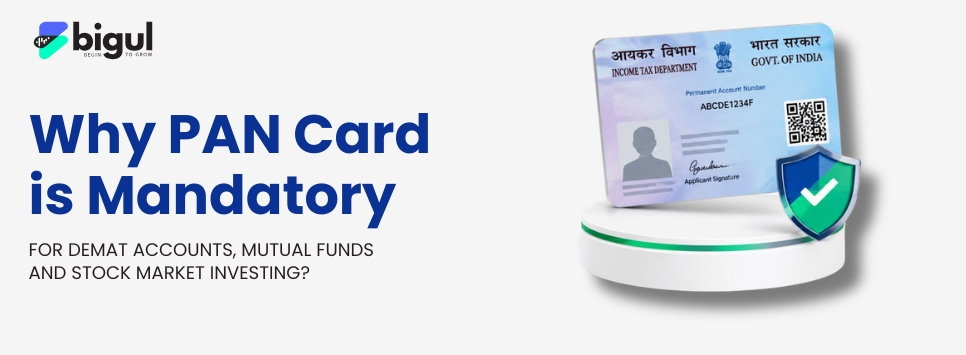
Why PAN Card is Mandatory for Investing in India
If you want to invest in the Indian stock market, there is one document you cannot do without.
Your PAN card.
Because without it, you literally cannot open a demat account, buy mutual funds, apply for an IPO,
or trade derivatives.
Here is why:
What PAN Actually Does in Investing
PAN (Permanent Account Number) is a 10-digit identifier issued by the Income Tax Department. Every financial transaction you make in the markets gets linked to it. That is how the government tracks investment income, capital gains, and tax liability.
But beyond taxation, PAN is the foundation of KYC (Know Your Customer), the verification process that every SEBI-regulated broker, mutual fund, and depository must complete before you can invest.
Where is PAN Mandatory?
Demat Account
As per a SEBI circular issued on April 27, 2007, submitting your PAN card is mandatory when opening a demat account, regardless of investment size. No exceptions for residents. Both holders in a joint account must submit their respective PAN cards.
Want to open a demat account? [Open your free Bigul demat account here]
Stock Market Trading
Under Rule 114B(d) of the Income Tax Rules, PAN is mandatory for every stock market investor in India, including those investing through brokers, investment apps, or mutual fund platforms. No minimum portfolio size applies.
Mutual Funds
Before investing in mutual funds, you must complete the KYC process and provide your PAN information. PAN serves as a unique identifier across all mutual fund investments, ensuring all transactions are tied to one identity, even across multiple fund houses.
IPO Applications
Every IPO application submitted through ASBA or UPI requires a valid PAN. Without it, your application is rejected outright.
F&O and Derivatives
Investing in derivatives such as options and futures on Indian stock exchanges requires a PAN card.
PAN and Capital Gains Taxation
Every time you sell shares, mutual fund units, or property, the profit is classified as a capital gain and PAN is how the Income Tax Department tracks it.
Short-term capital gains on equity held under 12 months are taxed at 20%. Long-term capital gains on equity held over 12 months are taxed at 12.5% on gains above ₹1.25 lakh annually. Mutual fund capital gains follow similar rules depending on the fund type and holding period.
Without a valid, operative PAN, your broker cannot generate the correct Form 26AS. Your capital gains will not reflect correctly. And when you go to file your ITR, the numbers will not match, creating compliance problems with the Income Tax Department.
PAN keeps your tax records clean throughout your investing journey.
What Happens If Your PAN is Inoperative?
If your PAN is not linked to Aadhaar and has become inoperative, none of the above works.
Your demat account transactions can be blocked. Mutual fund purchases can fail at the KYC verification stage. Capital gains will attract higher TDS at 20% instead of standard rates. New account openings will be rejected.
This is why checking your Aadhaar-PAN link status is the foundation of your entire investing life.
→ Check your Aadhaar-PAN link status: https://eportal.incometax.gov.in
→ Read our complete guide: [Aadhaar-PAN Link Status Check: How to Verify, Fix Errors and Avoid Income Tax Issues in 2026]
Ready to start investing?
[Open your Bigul account in minutes]