



Trading vs Investing: What's the Difference?
 02-Sep-2026
 2 mins read
Trending Now
-

Turtlemint Fintech Solutions IPO GMP, Open Date, Price Band, Issue Size 18-Jun-2026
-
.jpg)
SpaceX IPO: Elon Musk Becomes World's First Trillionaire — Key Facts Explained 13-Jun-2026
-

Zepto IPO, Open Date, Issue Size, Price Band and UDRHP Filed 12-Jun-2026
-

Shah Metacorp Rights Issue May 2026 Details, Record Date, Issue Price 26-May-2026
-

Jio Is Going Public. Here's What That Actually Means for You 11-May-2026
-

Parle Products IPO: India’s Most Iconic Biscuit Brand Going Public? 30-Apr-2026
-
Gujarat Cotex Rights Issue 2026 Details, Record Date, Issue Price 27-Mar-2026
-
.jpg)
Avi Polymers Rights Issue 2026 Details, Record Date, Issue Price 11-Feb-2026
-

D & H India Rights Issue 2026 Details, Record Date, Issue Price 05-Feb-2026
-

Avasara Finance Rights Issue 2025 Details, Record Date, Issue Price 29-Dec-2025

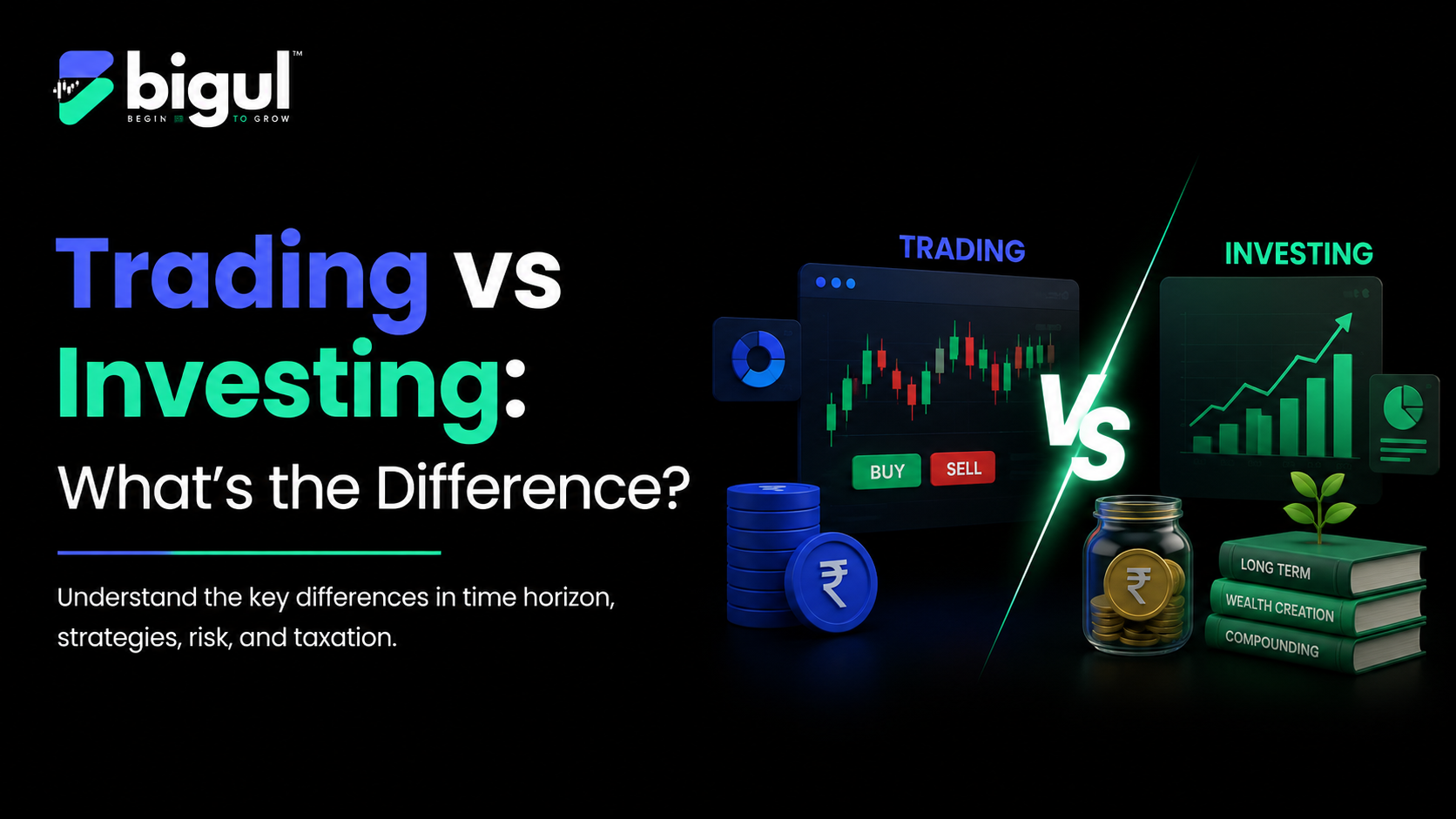
Trading vs Investing: Understand the Key Differences in Strategy, Risk, Time Horizon and Taxation
Most people use the words trading and investing interchangeably.
They are not the same thing.
They involve different timeframes, different skills, different tax treatments, and fundamentally different relationships with the market. Understanding which one you are doing and which one you should be doing is one of the most important decisions you can make as a market participant.
Here is a clear breakdown of both.
What Is Trading?
Trading is the active buying & selling of financial instruments: stocks, derivatives, currencies, or commodities over short timeframes to profit from price movements.
A trader is not interested in owning a business for the long term. They are interested in the price movement of that business's stock over the next few minutes, hours, days, or weeks.
Trading comes in several forms:
Intraday trading: Positions opened & closed within the same trading session.
Swing trading: Positions held for a few days to a few weeks, capturing short- to medium-term price moves.
Options and F&O trading: Using derivatives to take leveraged positions on the direction of price movement within defined timeframes.
The defining characteristic of trading is activity. Traders monitor charts, track technical indicators, manage stop losses and make frequent decisions based on price action rather than business fundamentals.
What Is Investing?
Investing is the purchase of financial assets, typically stocks or mutual funds, with the intention of holding them over months, years, or decades to benefit from the underlying growth of the business and the compounding of returns over time.
An investor is buying a share of a business. They are interested in whether the company will be worth more in ten years, not whether the stock price will move in the next ten minutes.
Investing also comes in several forms:
Direct equity investing: Selecting individual stocks based on fundamental research & holding them for the long term.
Mutual fund investing through SIPs: Systematic monthly investment in professionally managed or index funds over long periods.
Index investing: Buying the entire market through index funds and holding through all market conditions.
The defining characteristic of investing is patience. The investor's edge is time and the compounding that time enables.
The Key Differences
|
Factor |
Trading |
Investing |
|
Time horizon |
Minutes to weeks |
Months to decades |
|
Primary tool |
Technical analysis, price action |
Fundamental analysis, business quality |
|
Activity level |
High — frequent decisions |
Low — buy and hold |
|
Risk |
Higher — leverage, volatility, timing |
Lower over long periods — diversification, compounding |
|
Tax treatment |
STCG 20% or business income for F&O |
LTCG 12.5% above ₹1.25L after 12 months |
|
Capital required |
Can start small — leverage available |
Benefits from larger, consistent contributions over time |
|
Skill required |
Technical analysis, risk management, discipline |
Business analysis, patience, emotional discipline |
What Actually Happens?
Trading sounds compelling.
According to SEBI's latest study, nearly 9 in 10 retail F&O traders in India lost money in FY26 with aggregate losses of ₹91,685 crore. Globally, research consistently shows that 80%-90% of day traders lose money over time, with only 1%-3% achieving consistent profitability.
India now accounts for 60% of global equity derivatives trading volume, reflecting the scale of retail participation in short-term trading.
Long-term investors tell a different story.
SIP investors have grown from 3.1 crore in FY20 to 11 crore in FY25. The number of unique registered investors in India stands at 12.7 crore as of January 2026, a participation boom driven largely by long-term wealth creation goals.
Long-term equity investing has historically delivered approximately 12% to 15% CAGR in India over extended periods, significantly outperforming most active traders on a risk-adjusted basis.
Tax Treatment — An Important Difference
The tax treatment of trading & investing is meaningfully different.
For investors: Gains on equity held for more than 12 months are taxed as long-term capital gains at 12.5% on profits above ₹1.25 lakh per year. Gains on equity held for less than 12 months attract short-term capital gains tax at 20%.
For traders: F&O trading income is classified as business income & taxed at the applicable income slab rate, which can be significantly higher. F&O traders also cannot benefit from the lower LTCG rates regardless of how long they hold.
Can You Do Both?
Yes, and many market participants do.
A common approach is to maintain a core long-term investment portfolio built around quality businesses or index funds and allocate a separate, defined portion of capital to active trading.
The key is keeping the two completely separate. Trading capital should be money you can afford to lose. Investment capital should be money you are committed to leaving untouched for years.
Mixing the two, using long-term investment capital to fund short-term trades, is where most participants go wrong.
Which Is Right For You?
Time available: Trading requires daily attention, market monitoring, & active decision-making. Investing requires periodic review, not daily involvement.
Skills and temperament: Trading requires technical knowledge, risk-management discipline, and the ability to make fast decisions under pressure. Investing requires patience, fundamental understanding, and the emotional discipline to hold through corrections.
Financial goals: If your goal is long-term wealth creation, a retirement corpus, a child's education or financial independence, investing is the more reliable path. If you have a genuine interest in markets, the time to develop skills, and capital you can afford to risk, trading can be a complementary activity.
FAQs
What is the minimum capital needed to start trading in India?
For F&O trading, margin requirements vary by contract. However, trading with very small capital limits position sizing and risk management.
Is F&O trading considered trading or investing?
F&O trading is classified as business income by the Indian tax authorities,not capital gains. This means F&O profits are taxed at your applicable income slab rate regardless of holding period.
Can a beginner start with trading?
Beginners are generally better served starting with long-term investing to understand market behaviour before adding active trading. The learning curve for consistent profitable trading is steep and takes time.
What is the tax on long-term investing in India?
Gains on listed equity held for more than 12 months are taxed at 12.5% on profits above ₹1.25 lakh per year under the long-term capital gains tax provisions.
Also Read :- How to choose your first stock for Investment