



Best Global ETFs for Indian Investors (2026)
 05-Aug-2026
 2 mins read
Trending Now
-

Turtlemint Fintech Solutions IPO GMP, Open Date, Price Band, Issue Size 18-Jun-2026
-
.jpg)
SpaceX IPO: Elon Musk Becomes World's First Trillionaire — Key Facts Explained 13-Jun-2026
-

Zepto IPO, Open Date, Issue Size, Price Band and UDRHP Filed 12-Jun-2026
-
Shah Metacorp Rights Issue May 2026 Details, Record Date, Issue Price 26-May-2026
-

Jio Is Going Public. Here's What That Actually Means for You 11-May-2026
-

Parle Products IPO: India’s Most Iconic Biscuit Brand Going Public? 30-Apr-2026
-
Gujarat Cotex Rights Issue 2026 Details, Record Date, Issue Price 27-Mar-2026
-
.jpg)
Avi Polymers Rights Issue 2026 Details, Record Date, Issue Price 11-Feb-2026
-

D & H India Rights Issue 2026 Details, Record Date, Issue Price 05-Feb-2026
-

Avasara Finance Rights Issue 2025 Details, Record Date, Issue Price 29-Dec-2025

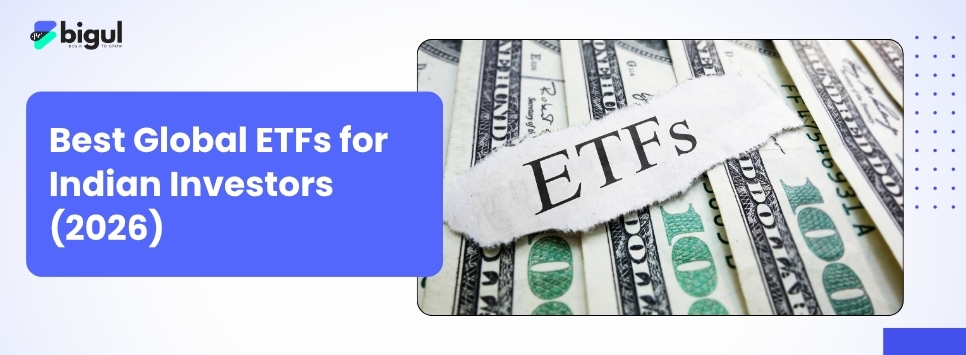
Compare S&P 500 and Nasdaq-100 ETFs to build a globally diversified investment portfolio.
The Nasdaq-100 returned 55% in 2023, 26% in 2024, and 21% in 2025. Three straight years of double-digit gains, while most Indian portfolios barely moved. The answer is not bad fund selection.
It is geography.
The good news: picking the best global ETF for Indian investors is simpler than it looks - two routes get
you there: the Liberalised Remittance Scheme - same markets, same indices, but very different on cost, tax, and mechanics.
Why Diversify Internationally?
Think about India's rougher market patches - Nifty flat, portfolios bleeding. Meanwhile, US tech
was on a completely different trajectory. That is not a coincidence. That is two market cycles running at the same time.
When your Indian holdings are struggling, your global exposure might be
doing the heavy lifting. Global portfolio diversification for Indian investors means going across economies running on different engines.
On currency: a weaker rupee lifts the rupee value of your dollar holdings. A stronger rupee trims it.
The underlying investment adds another layer - not a simple hedge, but the currency tailwind
has historically worked in favour of Indian investors going global.
US Index ETFs (S&P 500, Nasdaq 100) Available to Indian Investors
What is the S&P 500? It is a list of America's 500 largest publicly listed companies - the biggest
banks, tech giants, retailers, healthcare companies - all in one index. Think Apple, Microsoft,
Nvidia, JPMorgan, Johnson & Johnson. It covers the whole economy, not just one sector.
For an Indian investor, one trade gives you a slice of corporate America, the kind of exposure most Indian portfolios have never had.
These companies dominate globally, priced in dollars - the most direct way to invest in the S&P 500 from India. When Indian markets are sluggish, this basket may be running on a completely different track.
What is the Nasdaq-100? The 100 biggest non-financial companies on Nasdaq. No banks. Mostly
tech - Nvidia, Apple, Meta, Amazon, Tesla. Most Nasdaq 100 funds in India track this basket.
For you, it is concentrated growth. More upside when tech runs, sharper drawdowns when it
does not. If the S&P 500 is a diversified meal, the Nasdaq-100 is one dish ordered every time -
rewarding when the kitchen is firing, risky when it is not.
|
Feature |
S&P 500 |
Nasdaq-100 |
|---|---|---|
|
Coverage |
~500 committee-selected companies |
100 largest eligible non-financial companies on Nasdaq |
|
Weighting |
Float-adjusted market-cap |
Modified market-cap |
|
Maintenance |
Quarterly rebalancings; constituent changes between rebalancings as required |
Annual December reconstitution; quarterly rebalancing |
Source: S&P DJI; Nasdaq
Indian Mutual Funds with Global ETF Exposure
Don't want to open a foreign account? International mutual funds in India cover this - pick an S&P 500
index fund in rupees, a Nasdaq 100 feeder fund or FoF, or an Indian-listed ETF you trade like any stock.
The AMC handles the currency conversion, custody, and execution - you never touch a foreign account.
One catch: these funds sit within SEBI's overseas investment limits. As fund houses approach their
caps, availability can change - check with the AMC before investing.
Direct US ETF Investment vs Feeder Funds
Want to go direct? Under the LRS, you can remit up to USD 250,000 a year and buy foreign-listed
ETFs through an overseas-enabled broker. Cross ₹10 lakh and you pay 20% TCS - creditable against your income tax.
|
Factor |
Direct US ETF (LRS route) |
India-domiciled fund / ETF |
|---|---|---|
|
Process |
Buy foreign-listed ETF via overseas-enabled broker |
Buy in rupees through an Indian AMC |
|
Account |
Overseas brokerage account |
AMC folio (demat for on-exchange ETFs) |
|
Currency |
Investor converts INR at each remittance |
AMC manages FX within the scheme |
|
LRS |
Counts toward the investor's annual LRS limit |
Not applicable |
|
TCS |
Applies above the applicable threshold; creditable |
Not applicable |
Source: RBI LRS Master Direction; SEBI
Costs, Taxation & Expense Ratios Compared
Costs stack up differently by route. A feeder fund or FoF layers its own expense ratio on top of the
underlying ETF's. A regular plan adds distributor commission a direct plan skips. On-exchange
buying adds brokerage and the bid-ask spread.
|
Cost element |
Direct US ETF |
Feeder / FoF |
On-exchange ETF |
|---|---|---|---|
|
Fund-level TER |
Underlying ETF's TER |
Scheme TER + underlying TER |
Scheme TER |
|
Distribution |
Not applicable |
Regular adds commission; direct does not |
Not applicable |
|
Trading & FX |
Brokerage, spread; FX per remittance |
Transacted at NAV; FX managed in-scheme |
Brokerage, spread, NAV premium/discount |
|
Exit/other |
Platform fees; TCS above threshold |
An exit load may apply on early exit |
Transaction charges |
On tax: for India-domiciled international funds outside the amended Section 50AA definition, units
held over 24 months are taxed at 12.5% LTCG without indexation. Sell earlier and slab rates apply.
The ₹1.25 lakh exemption under Section 112A applies to listed equity funds - not automatically to
international funds or FoFs.
For direct foreign-listed ETFs, capital gains fall under Indian provisions for foreign capital assets. US
dividends face withholding; eligible Indian residents can claim the 25% India-US treaty rate via Form
W-8BEN. The dividend is also taxable in India, with a Foreign Tax Credit under Rule 128 via Form
67.
The routes below are for reference only, not ranked or recommended.
|
Scheme / ETF |
Route & structure |
Benchmark |
|---|---|---|
|
Open-ended index fund (INR) |
S&P 500 TRI |
|
|
Open-ended ETF (on-exchange) |
NASDAQ-100 TRI |
|
|
Open-ended FoF (INR) |
Nasdaq-100 (via MO ETF) |
|
|
Direct US ETF (unit investment trust) |
Nasdaq-100 |
|
|
Direct US ETF (trust) |
S&P 500 |
How to Pick the Right Global ETF for Your Portfolio
Tracking difference is the gap between a fund's return and its benchmark.
Tracking error measures how consistent that gap is. Both matter alongside expense ratio, liquidity,
and currency exposure.
And this is where most people miss out: the route matters as much as the index. The same Nasdaq-100 benchmark can carry very different costs and tax treatment depending on whether you're in a feeder fund, a FoF, or a US index fund in India. Same destination - very different journey.