



Index Funds vs Actively Managed Mutual Funds: What Should You Choose?
 18-Aug-2026
 2 mins read
Trending Now
-

Turtlemint Fintech Solutions IPO GMP, Open Date, Price Band, Issue Size 18-Jun-2026
-
.jpg)
SpaceX IPO: Elon Musk Becomes World's First Trillionaire — Key Facts Explained 13-Jun-2026
-

Zepto IPO, Open Date, Issue Size, Price Band and UDRHP Filed 12-Jun-2026
-

Shah Metacorp Rights Issue May 2026 Details, Record Date, Issue Price 26-May-2026
-

Jio Is Going Public. Here's What That Actually Means for You 11-May-2026
-

Parle Products IPO: India’s Most Iconic Biscuit Brand Going Public? 30-Apr-2026
-
Gujarat Cotex Rights Issue 2026 Details, Record Date, Issue Price 27-Mar-2026
-
.jpg)
Avi Polymers Rights Issue 2026 Details, Record Date, Issue Price 11-Feb-2026
-

D & H India Rights Issue 2026 Details, Record Date, Issue Price 05-Feb-2026
-

Avasara Finance Rights Issue 2025 Details, Record Date, Issue Price 29-Dec-2025

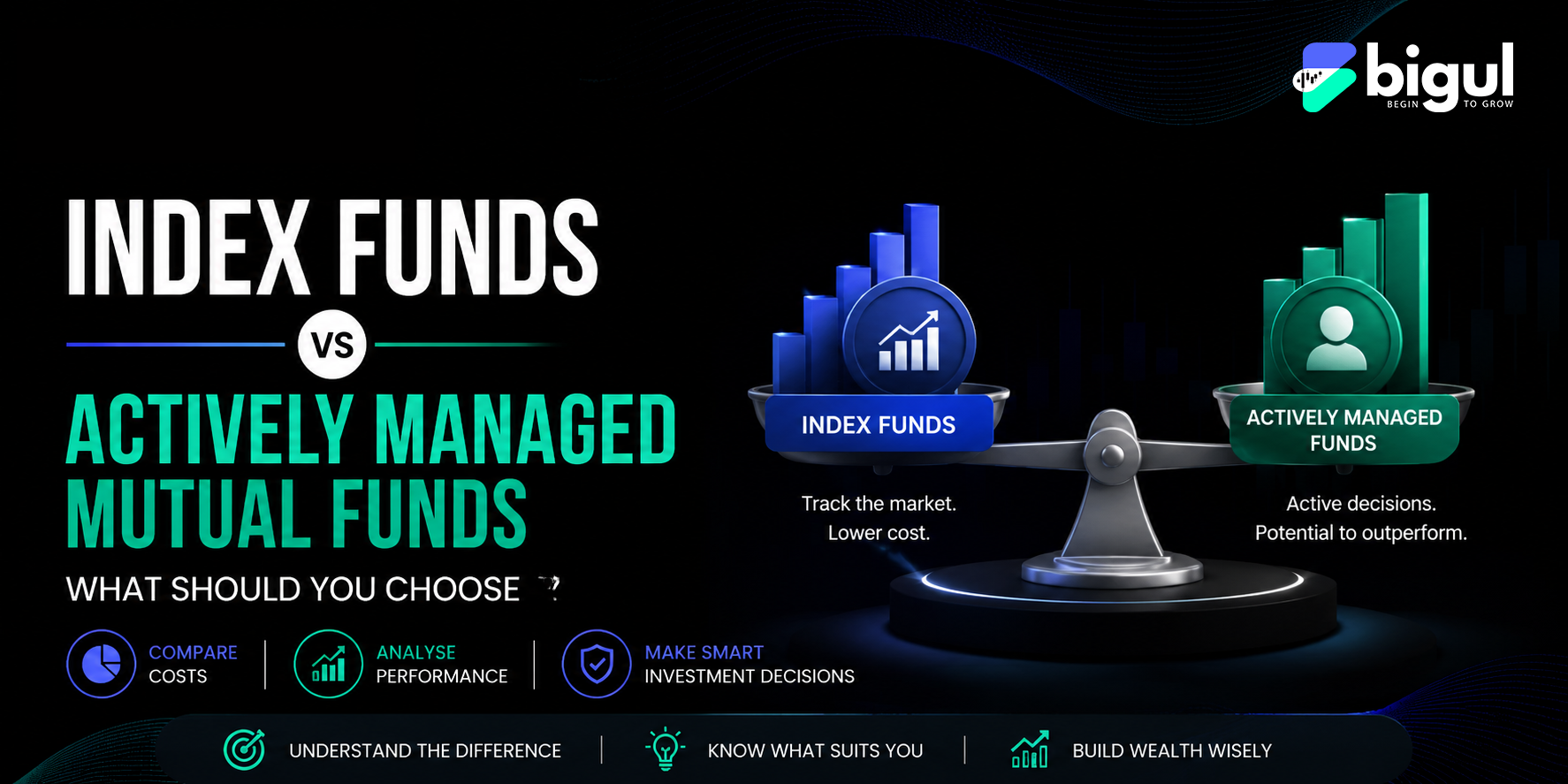
Index Funds vs Actively Managed Mutual Funds: Compare costs, performance, and investment approach.
You have decided to invest in mutual funds.
Now comes the next question: should you go with an index fund that simply tracks the market, or an actively managed fund where a professional fund manager makes the investment decisions?
Both are legitimate choices. The difference between them is in cost, in approach, and in what they actually deliver is worth understanding before you decide.
What Is an Index Fund?
An index fund is a passive investment. It simply tracks a market index like the Nifty 50 or Sensex by holding the same stocks in the same proportion as the index.
If the Nifty 50 goes up 12% in a year, a Nifty 50 index fund goes up approximately 12%. If it falls 10%, the fund falls approximately 10%.
No stock selection. No market timing. No fund manager makes calls on which company to buy or sell. Just the market as it is.
What Is an Actively Managed Fund?
An actively managed fund has a fund manager and a team of analysts whose job is to beat the market. They research companies, analyse sectors, and decide which stocks to buy, hold, or sell.
The goal is to deliver returns higher than the benchmark index. In a good year, an actively managed fund can significantly outperform the index. In a difficult year, it can underperform or protect better than the index, depending on the manager's calls.
Cost Comparison — The Expense Ratio
This is the most significant practical difference between the two.
Index funds have very low expense ratios typically between 0.10% and 0.20% per year. Because there is no active stock selection, the cost of running the fund is minimal.
Actively managed funds have higher expense ratios, typically between 0.50% & 1.50% per year for direct plans, and higher for regular plans. The cost covers the fund manager, the research team, and the higher trading activity involved in active management.
That difference may seem small but over twenty years, compounded on a large corpus, it is not.
A ₹10 lakh investment at 12% annual return over 20 years:
-
With 0.10% expense ratio: approximately ₹96 lakh
-
With 1.00% expense ratio: approximately ₹83 lakh
The expense ratio difference alone accounts for approximately ₹13 lakh in the final corpus without any difference in gross market returns.
Performance — Do Active Funds Beat the Index?
This is where most investors are surprised.
SPIVA India data which tracks how actively managed funds perform against their benchmarks, consistently shows that a significant majority of large cap actively managed funds underperform their benchmark index over five- and ten-year periods.
Over a ten-year period, more than 70% of large-cap active funds have failed to beat the Nifty 50 or Nifty 100 index.
That does not mean active funds never outperform. Some do consistently. But identifying those funds in advance, before the outperformance happens, is genuinely difficult. Last year's best-performing fund is not reliably this year's best-performing fund.
Mid-cap & small-cap funds have shown more consistent outperformance over benchmarks because these segments are less efficiently priced than large caps, giving skilled fund managers more opportunity to find mispriced stocks.
Which Should You Choose?
The answer depends on which segment you are investing in and what you are trying to achieve.
Consider index funds if:
-
You are investing in large cap equity
-
You want the lowest possible cost with market-matching returns
-
You prefer simplicity; one fund, one clear outcome, no dependency on fund manager decisions
-
You are investing for a long horizon of ten years or more where cost compounding matters significantly
Consider actively managed funds if:
-
You are investing in mid cap or small cap segments where skilled managers have historically added value over benchmarks.
-
You are comfortable evaluating fund performance and are willing to monitor and switch if needed.
-
You are investing in categories like flexi-cap or multi-cap, where manager discretion across market caps can add value.
-
You have a specific fund with a strong long-term track record and consistent process.
Can You Use Both?
Yes, many experienced investors do.
A portfolio with a Nifty 50 index fund as the large-cap core, keeping costs low and market exposure guaranteed, combined with actively managed mid-cap or small-cap funds where active management has historically added more value, is a structure worth considering.
It gives you cost efficiency where active funds struggle to justify their fees, and active management where the opportunity to outperform is more meaningful.
FAQs
Are index funds safe?
Index funds carry market risk; if the market falls, the fund falls. They are low-cost and transparent but not risk-free.
Which index fund should I choose in India?
When comparing funds tracking the same index, the expense ratio is the key differentiator- lower cost means more of your return stays with you. Consult a SEBI-registered advisor for personalised guidance.
Can index funds give better returns than active funds?
Historically, index funds have been cost-efficient in large-cap segments, but outcomes depend on market conditions, time horizon, and the specific funds compared.
What is tracking error in an index fund?
Tracking error is the gap between the fund's returns and the actual index returns. A lower tracking error means the fund is replicating the index more closely.
Should I switch from active to index funds?
That depends on your current fund's performance, costs, and your financial goals. Consult a SEBI-registered financial advisor before making any switch.
Also read : How to start SIP with small amount