



UPI MDR 2026: What Are the New Charges and What Do They Mean for You?
 18-Sep-2026
 2 mins read
Trending Now
-

Turtlemint Fintech Solutions IPO GMP, Open Date, Price Band, Issue Size 18-Jun-2026
-
.jpg)
SpaceX IPO: Elon Musk Becomes World's First Trillionaire — Key Facts Explained 13-Jun-2026
-

Zepto IPO, Open Date, Issue Size, Price Band and UDRHP Filed 12-Jun-2026
-
Shah Metacorp Rights Issue May 2026 Details, Record Date, Issue Price 26-May-2026
-

Jio Is Going Public. Here's What That Actually Means for You 11-May-2026
-

Parle Products IPO: India’s Most Iconic Biscuit Brand Going Public? 30-Apr-2026
-
Gujarat Cotex Rights Issue 2026 Details, Record Date, Issue Price 27-Mar-2026
-
.jpg)
Avi Polymers Rights Issue 2026 Details, Record Date, Issue Price 11-Feb-2026
-

D & H India Rights Issue 2026 Details, Record Date, Issue Price 05-Feb-2026
-

Avasara Finance Rights Issue 2025 Details, Record Date, Issue Price 29-Dec-2025
UPI MDR 2026: Understanding the New Merchant Charges and Their Impact
If you have been seeing headlines about UPI charges; here is the simple, clear version of what is
actually changing, who it affects, and what it means for everyday users.
Spoiler: if you use UPI to send money to friends or pay at small shops, nothing changes for you.
What Happened?
On September 15 2026, NPCI, the National Payments Corporation of India announced a new
Merchant Discount Rate framework for select UPI transactions.
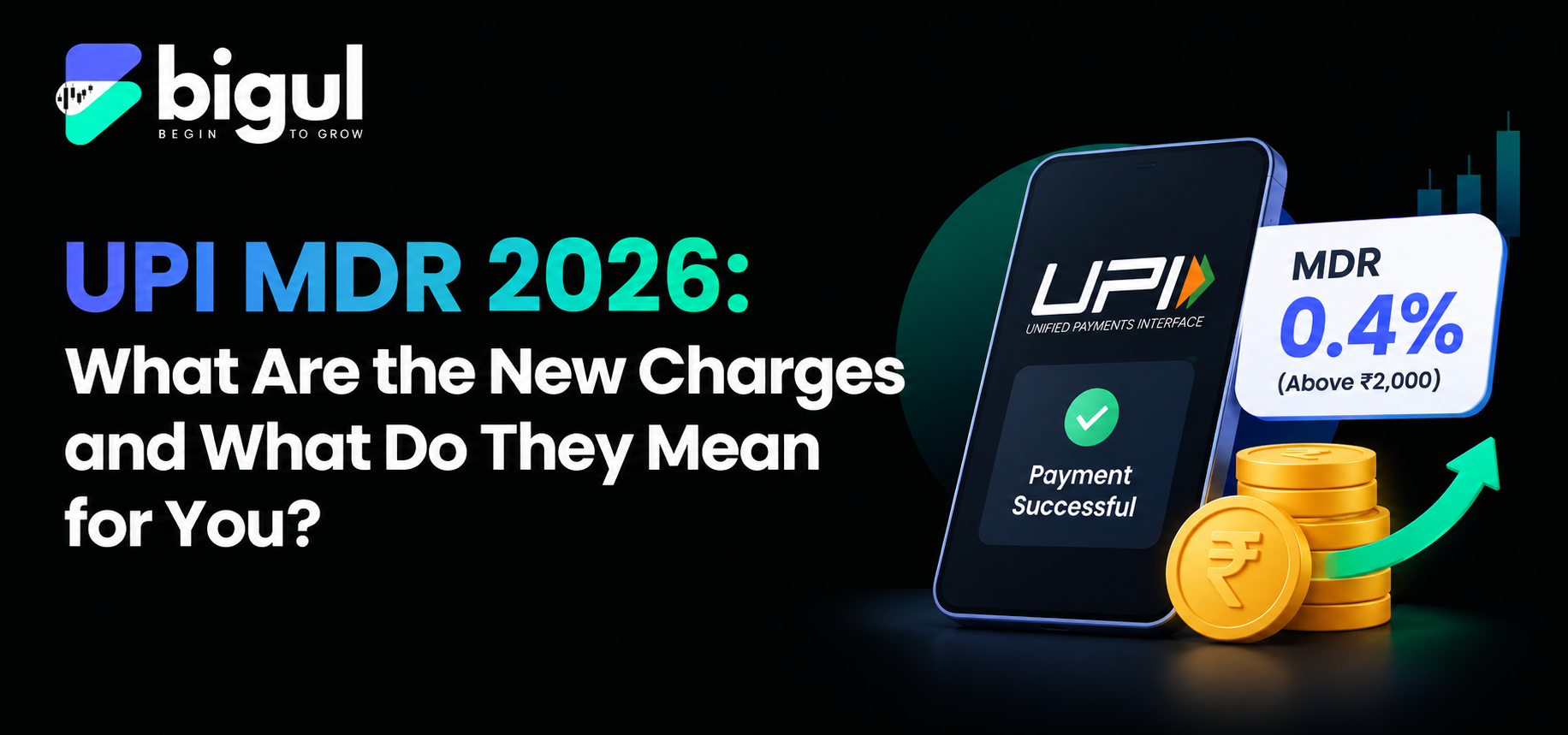
From October 15 2026, a 0.4% MDR will apply to certain UPI person-to-merchant payments above ₹2,000.
What Is MDR?
MDR stands for Merchant Discount Rate.
It is not a new concept. It is the fee that merchants pay to banks and payment service providers for processing digital payments, a cost that has always existed for credit cards and debit cards.
Credit card MDR in India typically ranges from 1.5%-2.5%. Debit card MDR is capped at 0.90%.
UPI had zero MDR since 2020, when the government waived it to promote digital payments. That zero-MDR policy made UPI the most cost-effective payment method for merchants and drove its extraordinary adoption.
The new 0.4% MDR for select transactions is significantly lower than card MDR but it ends the six-year period of completely free merchant UPI acceptance for larger transactions.
Who Does This Affect?
NOT affected:
-
All person-to-person UPI transfers sending money to friends, family, anyone remain completely free regardless of amount
-
All UPI payments to merchants up to ₹2,000 remain zero MDR
-
Small merchants, street vendors and small businesses receiving up to ₹1 lakh per month under the P2PM category remain under zero MDR
-
UPI AutoPay and mandates, recurring payments, utility bills, subscriptions, SIPs remain outside MDR entirely
-
Consumers will not pay anything extra when making a UPI payment. Merchants cannot pass MDR on to customers
AFFECTED:
-
Merchants receiving UPI person-to-merchant payments above ₹2,000, they will pay 0.4% MDR on those transactions from October 15 2026
The government has stated that approximately 96% of merchant UPI transactions will remain completely unaffected by this change.
How Much Does the MDR Actually Cost?
Here is a simple breakdown of what the MDR means in rupees:
|
Transaction Amount |
MDR at 0.4% |
What Merchant Pays |
|
₹1,999 or below |
Zero |
₹0 |
|
₹2,500 |
0.4% |
₹10 |
|
₹5,000 |
0.4% |
₹20 |
|
₹10,000 |
0.4% |
₹40 |
|
₹25,000 |
0.4% |
₹100 |
|
₹50,000 |
0.4% |
₹200 |
|
₹75,000 and above |
Capped |
₹300 maximum |
For transactions of ₹75,000 and above, the MDR is capped at ₹300 per transaction. No matter how large the transaction, the merchant never pays more than ₹300.
Where Does the MDR Money Go?
The MDR collected is distributed among the payment ecosystem participants; banks, payment service providers, and UPI application providers.
Additionally, 5% of total MDR collections will go into a dedicated fund to support digital payment infrastructure, merchant onboarding, and UPI expansion specifically targeting small merchants in Tier III-VI cities.
The stated purpose of introducing MDR is to support the long-term sustainability of UPI's infrastructure, cybersecurity, fraud monitoring, and operational resilience. UPI now processes billions of transactions monthly, maintaining and improving that infrastructure has a real cost.
Why Is This Happening Now?
UPI has been operating on a zero-MDR model for six years funded largely by government subsidies to banks.
UPI MDR remains significantly lower than traditional payment acceptance costs, with credit card MDRs typically ranging between 1.5% and 2.5%, and debit card MDRs capped up to 0.90%. UPI charges
As UPI has scaled to billions of transactions, the cost of maintaining the infrastructure has grown proportionately. The zero-MDR policy, while excellent for adoption, created a situation where the payment ecosystem had no sustainable revenue model.
The 0.4% MDR on larger merchant transactions is designed to create that sustainability while keeping the vast majority of everyday transactions completely free.
What About SIP Investments Through UPI?
Good news for investors: UPI AutoPay and mandate-based transactions including SIP investments remain completely outside the new MDR framework.
UPI Mandates and AutoPay transactions, including recurring utility bills, subscriptions and investments, remain outside MDR.
Your monthly SIP deducted through UPI AutoPay, unaffected. Your recurring mutual fund investment, unaffected. The MDR applies specifically to direct person-to-merchant payment transactions above ₹2,000.
Will Prices Go Up Because of MDR?
NPCI has been clear, merchants cannot pass MDR on to customers.
The customer continues to pay the price displayed by the merchant. Banks have been advised against passing MDR to customers, and UPI apps cannot impose platform fees or hidden charges.
Whether merchants adjust pricing to absorb the cost over time is a separate commercial decision but
the MDR itself cannot be charged directly to the consumer at the point of payment.
Quick Summary
|
What |
Details |
|
MDR rate |
0.4% on eligible P2M transactions above ₹2,000 |
|
Cap |
₹300 maximum per transaction |
|
Effective date |
October 15 2026 |
|
Who pays |
Merchants — not consumers |
|
P2P transfers |
Free — no change |
|
Transactions below ₹2,000 |
Free — no change |
|
Small merchants (P2PM under ₹1L/month) |
Free — no change |
|
UPI AutoPay & SIPs |
Free — no change |
FAQs
Will I be charged for sending money through UPI?
No. Person-to-person UPI transfers remain completely free regardless of the amount.
Will my UPI payment at a small shop cost more?
No. Small merchants receiving up to ₹1 lakh per month remain under zero MDR. Payments up to ₹2,000 to any merchant also remain free.
Will my SIP through UPI AutoPay be affected?
No. UPI AutoPay and mandate-based transactions including SIPs and recurring payments are outside the MDR framework.
Can a merchant add a surcharge for UPI payments?
No. Merchants cannot pass MDR on to customers. The customer pays the price displayed, nothing more.
What if I pay ₹74,999 through UPI?
The MDR would be 0.4%, approximately ₹299.99. For ₹75,000 and above, the MDR is capped at ₹300.
Also Read : - New Income tax slab