



Nifty IT Index Hits 30-Month Low in 2026: Sentiment or Structural Shift?
 22-Apr-2026
 2 mins read
Trending Now
-

Turtlemint Fintech Solutions IPO GMP, Open Date, Price Band, Issue Size 18-Jun-2026
-
.jpg)
SpaceX IPO: Elon Musk Becomes World's First Trillionaire — Key Facts Explained 13-Jun-2026
-
Zepto IPO, Open Date, Issue Size, Price Band and UDRHP Filed 12-Jun-2026
-
Shah Metacorp Rights Issue May 2026 Details, Record Date, Issue Price 26-May-2026
-

Jio Is Going Public. Here's What That Actually Means for You 11-May-2026
-

Parle Products IPO: India’s Most Iconic Biscuit Brand Going Public? 30-Apr-2026
-
Gujarat Cotex Rights Issue 2026 Details, Record Date, Issue Price 27-Mar-2026
-
.jpg)
Avi Polymers Rights Issue 2026 Details, Record Date, Issue Price 11-Feb-2026
-

D & H India Rights Issue 2026 Details, Record Date, Issue Price 05-Feb-2026
-

Avasara Finance Rights Issue 2025 Details, Record Date, Issue Price 29-Dec-2025

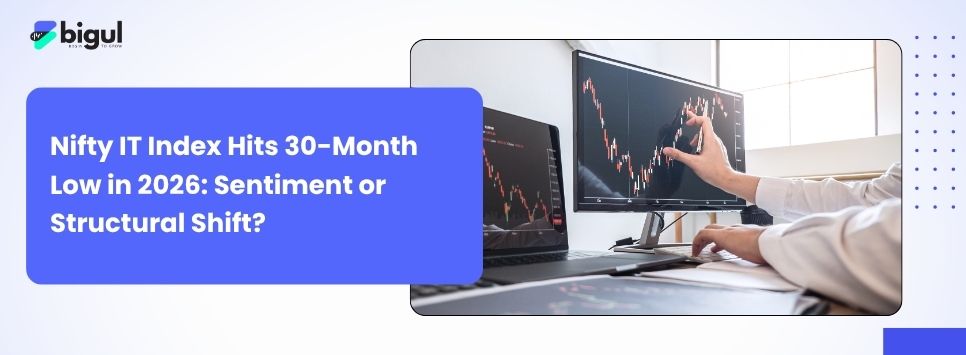
Nifty IT Index Hits 30-Month Low in 2026: Sentiment-Driven Fall or Structural Shift?
The Nifty IT index has emerged as one of the worst-performing sectoral indices in 2026, declining approximately 16.9% year-to-date as of April 21, 2026. Stocks such as HCL Technologies, Infosys, TCS, and Tech Mahindra have faced sustained selling pressure across multiple sessions. With Q4 FY26 results now coming in, the key question investors are asking is whether this correction reflects a real change in business fundamentals — or whether it is largely sentiment-driven.
So far, the evidence leans toward the latter.
Why Is the Nifty IT Index Falling in 2026?
The sell-off has been driven by a mix of macro concerns and investor anxiety around AI, not by any visible deterioration in quarterly earnings.
The dominant fear is AI disruption. Investors worry that advanced AI tools — capable of writing code, handling software testing, and modernising legacy systems — could compress billing and reduce deal sizes for Indian IT firms over time. HSBC, in its sector analysis, flagged a potential 14–16% AI deflation impact across IT revenue sub-segments as a medium-term risk, as AI makes work faster and cheaper for clients. This has triggered a sentiment-driven re-rating of the sector, even though the impact has not yet shown up in actual deal pricing.
US tariffs and slower discretionary tech spending have added to the uncertainty. Since Indian IT companies earn a significant portion of their revenue from US clients, any pullback in tech budgets hits them directly. Clients have been cautious about committing to large projects, contributing to slower deal closures.
FII Selling Pushes Overall NSE Ownership to 15-Year Low
Overall FPI ownership in NSE-listed companies dropped to 16.9% as of Q2 FY26, the lowest in over 15 years, according to NSE's India Ownership Tracker. This is a market-wide figure, but the IT sector has been among the hardest hit, with foreign investors cutting exposure sharply through February and March 2026. During the peak of the sell-off in February 2026, net FII outflows from Indian equities ran into tens of thousands of crore within a matter of weeks.
Domestic institutional investors have absorbed a large part of this selling — domestic mutual fund ownership hit a record high of 10.9% during the same period — which has prevented a deeper market dislocation.
HCL Tech, Infosys, Tech Mahindra Stock Performance in 2026
The decline has been broad-based across Nifty IT constituents. During peak correction sessions in late February 2026, LTIMindtree fell close to 7%, Tech Mahindra dropped over 6%, and Persistent Systems and Coforge each declined more than 6% in a single session. HCL Technologies slid nearly 6%. Infosys and TCS fell around 3.5% each. The Nifty IT index itself touched a 30-month low of 30,054 on February 24, 2026.
Analysts at Choice Broking noted that the index had formed a death cross — a short-term moving average falling below a long-term one — signalling a shift in trend, and suggested a "sell on rise" approach for traders in the near term.
Nifty IT Q4 FY26 Results: Numbers and Key Metrics to Watch
The actual Q4 numbers tell a different story from the market sentiment. HCL Technologies, which reported on April 21, posted a 4.2% rise in net profit to ₹4,488 crore in Q4 FY26, with revenue growing 12.34% year-on-year to ₹33,981 crore. The board also declared an interim dividend of ₹24 per share for FY27 — a sign of confidence in near-term cash flows.
Importantly, CLSA, after pre-results interactions with TCS, Infosys, HCL, and Wipro, found no evidence of AI-led pricing pressure in deal renewals in Q4. Deal pipelines across the four companies remained intact, and vertical-wise demand commentary was broadly stable. This confirms that the sell-off has been driven more by investor sentiment than by actual fundamental damage so far.
Tech Mahindra declared its Q4 results on April 22. Infosys — the sector bellwether — announces on April 23. The FY27 revenue guidance from Infosys will be the single most important data point of this earnings season. A confident upgrade could lift the entire IT pack; a cautious range will weigh further on sentiment.
Key metrics analysts are tracking across Q4 results include deal wins in AI and digital transformation, demand from BFSI and healthcare verticals, margin trajectory, and any commentary on how AI is affecting contract structures.
Indian IT Sector Recovery Outlook for H2 2026
The correction has brought valuations to more reasonable levels. The Nifty IT index is now trading close to its 10-year average P/E — a level historically associated with improved long-term risk-reward for patient investors, though not a guarantee of near-term recovery.
The sector is likely to remain range-bound until there is more clarity on US tech spending, Federal Reserve rate direction, and visible revenue flow from AI-related projects. Indian IT majors have been actively building AI capabilities, and as global enterprises move from AI pilots to actual deployment at scale, Indian IT firms are positioned to participate in that transition.
Whether this shapes up as a structural decline or a sentiment-driven correction that eventually corrects will depend almost entirely on what Q4 guidance numbers say — and how companies frame their FY27 outlook.