



IT Stocks See Profit Booking After Five-Day Rally
 31-Jul-2026
 2 mins read
Trending Now
-

Turtlemint Fintech Solutions IPO GMP, Open Date, Price Band, Issue Size 18-Jun-2026
-
.jpg)
SpaceX IPO: Elon Musk Becomes World's First Trillionaire — Key Facts Explained 13-Jun-2026
-

Zepto IPO, Open Date, Issue Size, Price Band and UDRHP Filed 12-Jun-2026
-
Shah Metacorp Rights Issue May 2026 Details, Record Date, Issue Price 26-May-2026
-

Jio Is Going Public. Here's What That Actually Means for You 11-May-2026
-

Parle Products IPO: India’s Most Iconic Biscuit Brand Going Public? 30-Apr-2026
-
Gujarat Cotex Rights Issue 2026 Details, Record Date, Issue Price 27-Mar-2026
-
.jpg)
Avi Polymers Rights Issue 2026 Details, Record Date, Issue Price 11-Feb-2026
-

D & H India Rights Issue 2026 Details, Record Date, Issue Price 05-Feb-2026
-

Avasara Finance Rights Issue 2025 Details, Record Date, Issue Price 29-Dec-2025
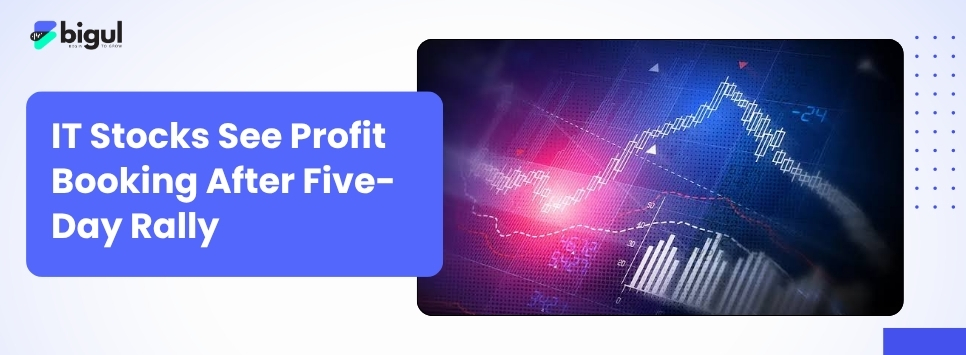
Indian IT stocks paused after a strong July rally, with investors booking profits as the Nifty IT index approached key resistance levels.
After one of its strongest runs in months, the Indian IT sector finally paused for breath. The Nifty IT index slipped as investors cashed out gains from a five-session rally that had pushed the index up nearly 16% in July alone, and over 21% from its 52-week low of 25,699.10 hit just 30 days ago on July 1. Infosys and TCS each fell up to 3%, dragging the broader IT pack lower on profit-booking pressure.
What Triggered the Selling
The IT sector had been on a tear. Strong Q1 FY27 results from TCS, Infosys, Coforge, HCL Technologies, and LTIMindtree — paired with improving deal wins, resilient margins, and management commentary that pointed toward a gradual demand recovery — gave investors enough confidence to pile back in. Add to that a Jefferies upgrade of the Indian IT sector, FII inflows returning to the market, and expectations that the US Federal Reserve would hold rates steady — and you had the ingredients for a sharp, fast rally.
What came next was predictable. After a five-session run where the Nifty IT index surged nearly 10% in a week, the index was stretched short-term. Infosys ADRs had rallied nearly 11% over the previous four trading sessions before slipping 2.5% overnight. Wipro ADRs, which had gained an extraordinary 25% across eight sessions, fell more than 8% in a single night. When ADRs correct that sharply on Wall Street, the Indian market takes notice the next morning.
Profit booking at these levels isn't a sign of weak conviction — it's a sign that a sector ran hard and fast, and some investors chose to ring the register.
The Month That Was: Nifty IT Up 16% in July
To understand why today's dip matters less than it appears, you need to zoom out to the full month. The Nifty IT index has gained nearly 16% in July 2026 — making it one of the best monthly performances for the index in recent years. Every single constituent of the Nifty IT index participated in the rally. Coforge led with outsized gains backed by strong Q1 FY27 earnings. Infosys, TCS, LTIMindtree, Wipro, HCL Technologies, and Persistent Systems all posted meaningful gains.
The index recovered more than 21% from its July 1 low — a low that had been set against a backdrop of global AI valuation concerns, weak discretionary tech spending, and a sluggish demand environment in North America. The recovery has been equally sharp because the underlying data — earnings, deal wins, margin stability — turned out to be better than the market had priced in during the correction.
What Changed: From AI Fear to AI Optimism
The story of Indian IT in 2026 has been a story of two narratives clashing. For the first half of the year, the dominant fear was that AI would displace Indian IT jobs and shrink the revenue pool — that clients would buy fewer services as AI made software development faster and cheaper. This narrative crushed IT stocks in the first six months, with the Nifty IT index falling roughly 35% from its peak before finding a floor.
What the Q1 FY27 earnings season showed — decisively — is that the opposite is playing out, at least for now. AI is generating new projects, not eliminating old ones. TCS reported an annualised AI revenue run rate of $2.6 billion, growing 13.6% sequentially. Infosys confirmed AI contributions at 8.2% of revenue. Coforge, LTIMindtree, and HCL Technologies all reported AI-led deal wins. Clients are not cutting back on IT spending because of AI — they are spending more, on AI transformation programs that require exactly the kind of large-scale engineering and integration work that Indian IT companies specialise in.
The rotation happening in global markets reinforced this further. Asian semiconductor stocks — which had been major beneficiaries of the AI investment cycle — saw profit booking as investors rotated into Indian IT, which was seen as a more direct beneficiary of enterprise AI adoption than chip stocks alone.
FIIs Are Back in the Room
One number that deserves attention alongside the IT rally is FII activity. On July 29, foreign institutional investors were net buyers of Indian equities to the tune of ₹755 crore — a small but symbolically important number after months of sustained outflows. The India VIX, a measure of market volatility, has been declining steadily — and lower volatility typically means more comfort for foreign capital to come back into risk assets.
This was also apparent from the overall market sentiment on 29th July. The Nifty crossed the 24,250 level, rising 264 points. The Sensex gained 888 points and reached 77,654 levels. IT stocks were once again leading the market for the third consecutive trading day, with Nifty IT up by 2.32%.
The Key Resistance Zone Now
After the July rally, the Nifty IT index faces its next meaningful test around the 31,800–32,000 zone. That level represents a key technical resistance — a zone the index needs to break convincingly to signal that the recovery is a trend rather than a bounce. A decisive move above 32,000 could open the door for further upside. A failure to break through could result in a period of consolidation at current levels as the market waits for the next earnings or macro trigger.
The immediate support on the downside is seen around 29,500 — backed by the 100-day EMA and the price gap from the July 28 rally session.
The Big Picture
Indian IT was one of the most beaten-down sectors in the first half of 2026. It has staged one of the sharpest recoveries in the second half of July. A single session of profit-booking after a 16% monthly rally does not change the fundamental picture — which is one of improving earnings, stabilising demand, a secular AI tailwind, and valuations that are still well below their historical peaks.
The Nifty IT index currently trades at approximately 23 times forward earnings — up from around 20 times at its July low, but still meaningfully below its all-time high multiple of 32 times. That gap is what gives bulls their long-term argument: if earnings continue to improve and AI optimism holds, the sector still has room to re-rate from here.