



India's First Weather Derivative Is Live: Here’s Everything You Need to Know About RAINMUMBAI
 28-May-2026
 2 mins read
Trending Now
-

Turtlemint Fintech Solutions IPO GMP, Open Date, Price Band, Issue Size 18-Jun-2026
-
.jpg)
SpaceX IPO: Elon Musk Becomes World's First Trillionaire — Key Facts Explained 13-Jun-2026
-

Zepto IPO, Open Date, Issue Size, Price Band and UDRHP Filed 12-Jun-2026
-
Shah Metacorp Rights Issue May 2026 Details, Record Date, Issue Price 26-May-2026
-

Jio Is Going Public. Here's What That Actually Means for You 11-May-2026
-

Parle Products IPO: India’s Most Iconic Biscuit Brand Going Public? 30-Apr-2026
-
Gujarat Cotex Rights Issue 2026 Details, Record Date, Issue Price 27-Mar-2026
-
.jpg)
Avi Polymers Rights Issue 2026 Details, Record Date, Issue Price 11-Feb-2026
-

D & H India Rights Issue 2026 Details, Record Date, Issue Price 05-Feb-2026
-
Avasara Finance Rights Issue 2025 Details, Record Date, Issue Price 29-Dec-2025

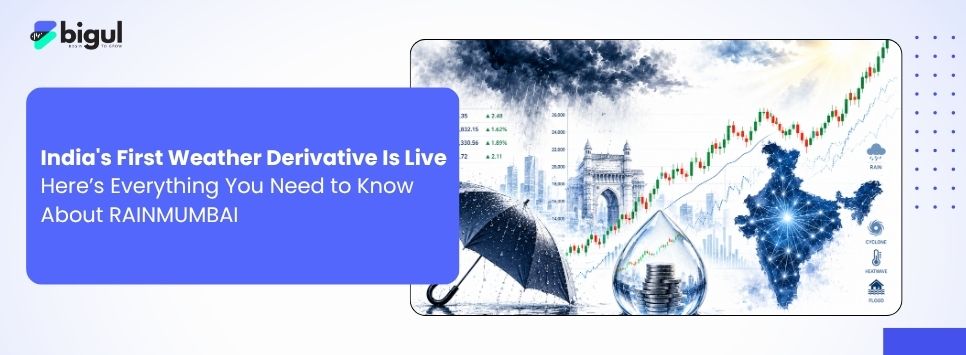
RAINMUMBAI: India's First Weather Derivative Explained
For a country where nearly half the workforce depends on agriculture and the monsoon determines whether Kharif crops succeed or fail, it's surprising that India had no formal financial instrument to hedge rainfall risk — until now.
On May 20, 2026, the National Commodity and Derivatives Exchange (NCDEX) announced the launch of RAINMUMBAI, India's first SEBI-approved exchange-traded weather derivative contract. Trading opened on May 29, right ahead of the monsoon season. This is not a pilot or an experiment — NCDEX has established it as an operational risk management product for a broad range of weather-exposed businesses and institutions.
Why Did This Take So Long?
The idea of weather derivatives in India isn't new. NCDEX first began exploring a weather-index-based product back in 2008. For nearly two decades, the concept circulated through regulatory committees, advisory panels, and exchange proposals without reaching the market.
This assertive regulatory shift occurred when weather derivatives were officially included under the Securities Contracts (Regulation) Act, 1956 (SCRA), this provides exchanges the legal framework to present them as listed products and be traded on.
Further that, the NCDEX exchange has signed an MoU with the India Meteorological Department (IMD) in July 2025, so that they can get real-time and historical rainfall data. The contract itself was developed in collaboration with IIT Bombay, adding scientific rigour to the index structure.
What is RAINMUMBAI?
RAINMUMBAI is a parametric cash-settled futures contract. There are no insurance claims, no site inspections, and no damage assessments involved. Settlement is entirely data-driven, which makes it faster and more transparent than traditional insurance mechanisms.
The underlying index is called the Cumulative Deviation Rainfall (CDR). It measures the difference between actual daily rainfall in Mumbai and the city's Long Period Average (LPA) of 2,206.7 mm across the monsoon months of June to September. A positive CDR value means above-average rainfall; a negative value means a deficit. When the contract expires, payouts are calculated automatically against this recorded deviation — no subjectivity involved.
Contract specifications, as per NCDEX's official announcement:
|
Parameter |
Detail |
|
Ticker |
RAINMUMBAI |
|
Contract type |
Cash-settled futures |
|
Tick size |
1 mm of rainfall |
|
Lot multiplier |
₹50 per mm |
|
Max order size |
50 lots |
|
Trading hours |
Mon–Fri, 10:00 AM – 11:30/11:55 PM |
|
Data source |
IMD surface observations + AWS at Santacruz & Colaba |
|
Historical benchmark |
30-year LPA dataset (1991–2020) |
The Scale of the Problem This Is Solving
The economic case for a product like this is straightforward when you look at what monsoon variability actually costs India.
Agriculture accounts for roughly 15–18% of India's GDP and uses near to 45% of the workforce. Around 60% of Indian farmers depend entirely on monsoon rainfall for their Kharif crop season. On a 30-year period, India has recorded approx $180 billion in losses from extreme weather events.
In 2025 alone, India recorded extreme weather events on 99% of days in the first nine months of the year, with 4,064 lives lost and 47 million hectares of cropped area damaged — a 400% increase in four years, according to a joint CSE and Down To Earth report.
The 2026 monsoon season, which RAINMUMBAI's first contracts are tied to, is already projected to be below normal by both IMD and Skymet, driven by El Niño conditions in the Pacific. Which means the first real test of this market is arriving under conditions that make hedging especially relevant.
Who Can Use This Contract?
NCDEX has designed RAINMUMBAI for any business with material exposure to Mumbai's rainfall patterns. The primary user base includes:
- Farmers and agri-businesses carrying Kharif crop risk
- Construction firms whose project timelines and costs get affected by the monsoon activity
- Power utilities whose demand patterns shift with rainfall
- Logistics operators whose Mumbai distribution networks are regularly impacted during heavy rain
- Banks and NBFCs having large agricultural loan portfolios
- Airlines such as IndiGo and SpiceJet, whose Mumbai operations face recurring disruptions from waterlogging and low visibility
NCDEX has also clarified that this product is meant to complement existing insurance and government relief mechanisms, not replace them — it's an additional, market-linked tool for managing exposure that traditional insurance processes poorly or slowly.
India Is Late to This Market — but the Foundation Is Right
Globally, weather derivatives have been around for decades. The Chicago Mercantile Exchange (CME) has offered weather futures linked to temperature, snowfall, and rainfall across multiple cities since 1999. India's entry brings a new domestic asset class to a market that had zero listed weather derivative penetration until now.
As NCDEX MD & CEO Arun Raste stated at the launch: "India has lived with monsoon uncertainty for centuries. RAINMUMBAI provides every stakeholder with a regulated, scientific tool to manage this uncertainty."
NCDEX has also indicated that RAINMUMBAI is the first product in what could expand into a wider asset class — rainfall derivatives for major agricultural districts and a temperature index for northern India are the next logical steps.
The Real Question: Are People Going to Trade in it?
Launching a derivatives contract and building a functional market for it are two different things. The CME's weather products took years to develop meaningful trading volumes, and they had the advantage of a deep, existing institutional participant base.
For RAINMUMBAI to work as a hedging tool, there needs to be a viable two-sided market — buyers seeking protection and counterparties willing to take on that risk at a fair price. If institutional players, corporate treasuries, and eventually global weather desks don't participate in meaningful numbers, spreads will widen and the product becomes too expensive to use effectively.
There's also the question of pricing model maturity. Weather risk valuation in Indian monsoon conditions is relatively untested at a market level, which means initial price discovery could be bumpy.