



FMCG Index Rises Over 2% Ahead of Q4 Results — HUL Tops Nifty 50 on Price Hikes
 17-Apr-2026
 2 mins read
Trending Now
-

Turtlemint Fintech Solutions IPO GMP, Open Date, Price Band, Issue Size 18-Jun-2026
-
.jpg)
SpaceX IPO: Elon Musk Becomes World's First Trillionaire — Key Facts Explained 13-Jun-2026
-
Zepto IPO, Open Date, Issue Size, Price Band and UDRHP Filed 12-Jun-2026
-
Shah Metacorp Rights Issue May 2026 Details, Record Date, Issue Price 26-May-2026
-

Jio Is Going Public. Here's What That Actually Means for You 11-May-2026
-

Parle Products IPO: India’s Most Iconic Biscuit Brand Going Public? 30-Apr-2026
-
Gujarat Cotex Rights Issue 2026 Details, Record Date, Issue Price 27-Mar-2026
-
.jpg)
Avi Polymers Rights Issue 2026 Details, Record Date, Issue Price 11-Feb-2026
-

D & H India Rights Issue 2026 Details, Record Date, Issue Price 05-Feb-2026
-

Avasara Finance Rights Issue 2025 Details, Record Date, Issue Price 29-Dec-2025

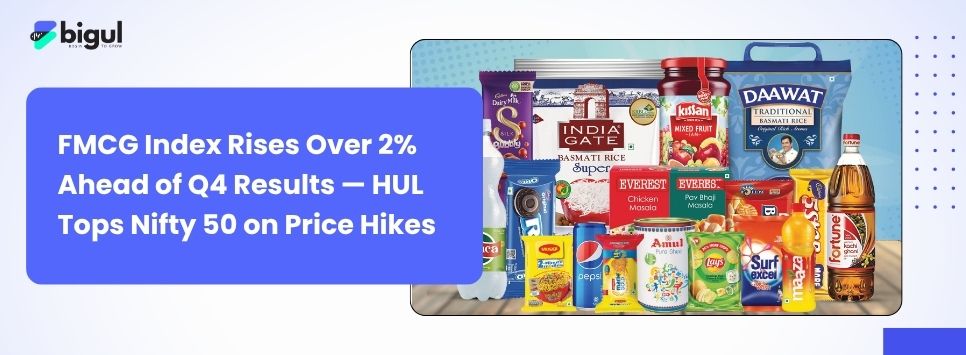
FMCG Index Jumps 2% Ahead of Q4 Results: HUL Leads Nifty 50 on Price Hikes
The Nifty FMCG index extended its recovery run ahead of the Q4 FY25 earnings season, rising over 2% in a single session and pushing Hindustan Unilever Limited (HUL) to the top of the Nifty 50 gainers list. The trigger was a combination of anticipated price hikes across key product categories and growing investor confidence that the FMCG sector's fundamentals are improving after a prolonged period of pressure.
Why Did HUL Lead the Nifty on That Day?
The market's attention was on HUL's selective price increases across categories including soaps and tea — a move that indicated the company's confidence in passing on costs without meaningfully hurting volumes. Pre-results, analysts at Axis Securities projected approximately 1.4% price-led growth for HUL in Q4 FY25, driven specifically by these hikes, even as volume growth was expected to stay flat given subdued urban demand conditions.
For a sector that had spent much of FY25 absorbing input cost pressures quietly, any indication of pricing power returning was a meaningful positive signal for markets.
The Bigger Picture: Nifty FMCG's Strong Recovery
HUL's single-session outperformance was part of a much broader sectoral recovery. According to data tracked by Outlook Money, the Nifty FMCG index recovered over 15% from its 52-week low hit in early March 2025, significantly outperforming the benchmark Nifty 50, which rose approximately 10% over the same period. The index had touched a 52-week low of 50,199.35 on March 4, 2025, after a prolonged correction from its record high of 66,438.70 set on September 27, 2024.
Several macro factors have been working in the sector's favour:
· Easing Inflation: According to MoSPI's official CPI press release dated April 15, 2025, retail inflation came in at 3.34% (provisional) in March 2025 — a 27 basis point decline from February 2025 and the lowest reading in several years. Lower inflation improves consumer purchasing power, which directly supports FMCG volume growth.
· Rural Recovery: Rural demand has been picking up on the back of a strong Rabi harvest, with another healthy monsoon anticipated for FY26. Rural markets contribute a significant share of FMCG volumes, making this a key structural positive.
· Budget Support for Urban Consumption: The Union Budget 2025 introduced personal income tax reductions aimed at boosting disposable income for urban households. Since urban consumption accounts for roughly half of FMCG volume and approximately two-thirds of FMCG value, any improvement in urban spending power has an outsized impact on the sector.
· Institutional Interest: FIIs net-purchased FMCG shares worth ₹587 crore during April 1–15, 2025, according to NSDL data cited by Outlook Money — reflecting renewed institutional confidence in the sector's near-term trajectory.
· Commodity Moderation: Raw material prices for key inputs including wheat, barley, corn, and crude derivatives are expected to moderate in H2 FY26, providing margin relief — though palm oil and copra prices remain areas of concern, as flagged by brokerages.
HUL Q4 FY25 Results: The Actual Numbers
When HUL released its Q4 FY25 results on April 24, 2025, the performance was steady on the revenue side but under some pressure on profitability.
Revenue from operations grew 3% year-on-year to ₹15,670 crore (Q4 FY24: ₹15,210 crore). Total income, including other income, rose 3.5% to ₹15,979 crore. However, consolidated net profit declined 3.67% year-on-year to ₹2,464 crore, compared to ₹2,558 crore in the corresponding quarter of the previous year. Sequentially, net profit saw a sharper 17.4% decline.
EBITDA came in at ₹3,466 crore, a marginal 0.9% improvement over the ₹3,435 crore reported in Q4 FY24. EBITDA margin, however, slipped 30 basis points to 23.1%, with gross margin declining 160 basis points year-on-year to 49.8%.
The company reported Underlying Sales Growth (USG) of 3% and Underlying Volume Growth (UVG) of 2% for the quarter — modest but in line with the broader demand environment.
Segment performance highlights:
- Beauty & Wellbeing delivered the highest growth at 6.6% YoY, with revenue at ₹3,265 crore
- Home Care (the largest revenue contributor at ~37% of total) posted moderate growth; pricing was partially offset by commodity deflation and competitive intensity in the detergents segment
- Food segment revenue saw a slight decline on a YoY basis
Following the results announcement, HUL's share price declined over 4% in trade on April 24, 2025.
What Management Indicated Going Forward
In the investor communication post results, HUL's MD & CEO Rohit Jawa said the company expects demand conditions to gradually improve over FY26. The company also revised its EBITDA margin guidance to 22–23%, lower than the previously expected range of 23–24%, citing input cost pressures.
On volume vs. price dynamics, the company indicated that if commodity prices remain stable, volume growth is expected to outpace price growth in FY26 — with price growth likely to stay in the low single-digit range.
On the portfolio front, HUL completed the acquisition of a 90.5% stake in D2C personal care brand Minimalist for ₹2,706 crore after receiving Competition Commission of India (CCI) approval. The company also divested Pureit and announced plans to demerge its Ice Cream business — part of a broader portfolio transformation strategy.
Key Monitorables for the FMCG Sector
Investors tracking the FMCG space should watch:
- Monsoon progress in FY26 — Sustaining rural volume recovery depends significantly on rainfall patterns
- Palm oil and copra prices — These remain elevated and could weigh on gross margins if they do not correct
- Urban demand recovery — A genuine revival in urban consumption (not just price-led growth) is needed for the sector's volume trajectory to improve meaningfully
- Demand commentary in Q1 FY26 results — Distribution network expansion, product innovation, and raw material price trends will be closely monitored, as highlighted in analyst reports.
This article is for informational and educational purposes only. It does not constitute investment advice, research, or a recommendation to buy, sell, or hold any securities. Data sourced from MoSPI, NSE, company investor presentations, and publicly available brokerage research. Readers are advised to consult an investment advisor before making any investment decision.