



EV Stocks Rally as Delhi Pulls the Plug on Petrol Two-Wheelers
 01-Jul-2026
 2 mins read
Trending Now
-

Turtlemint Fintech Solutions IPO GMP, Open Date, Price Band, Issue Size 18-Jun-2026
-
.jpg)
SpaceX IPO: Elon Musk Becomes World's First Trillionaire — Key Facts Explained 13-Jun-2026
-

Zepto IPO, Open Date, Issue Size, Price Band and UDRHP Filed 12-Jun-2026
-

Shah Metacorp Rights Issue May 2026 Details, Record Date, Issue Price 26-May-2026
-

Jio Is Going Public. Here's What That Actually Means for You 11-May-2026
-

Parle Products IPO: India’s Most Iconic Biscuit Brand Going Public? 30-Apr-2026
-
Gujarat Cotex Rights Issue 2026 Details, Record Date, Issue Price 27-Mar-2026
-
.jpg)
Avi Polymers Rights Issue 2026 Details, Record Date, Issue Price 11-Feb-2026
-

D & H India Rights Issue 2026 Details, Record Date, Issue Price 05-Feb-2026
-

Avasara Finance Rights Issue 2025 Details, Record Date, Issue Price 29-Dec-2025

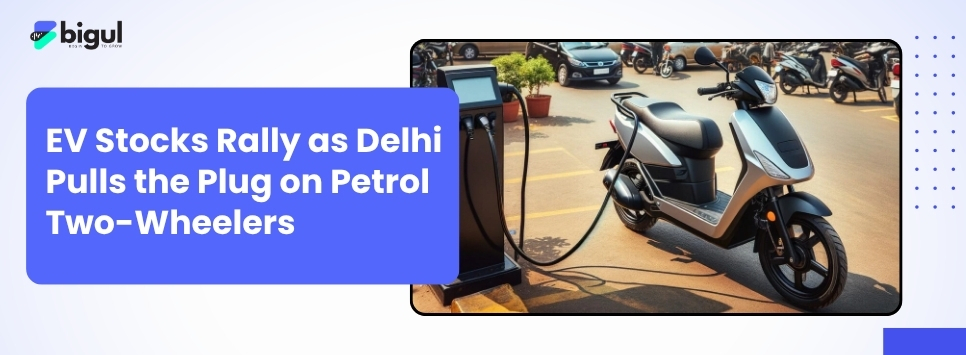
Delhi EV Policy 2026 mandates electric two-wheelers from 2028, boosting EV stocks, subsidies, and charging infrastructure across the capital.
Ather Energy hit a record high last week. Ola Electric gained 13% in two sessions.
The reason was a single policy document approved by the Delhi Cabinet on June 29, 2026.
If you are a Delhi resident who owns or plans to buy a two-wheeler, that same document affects you more than it affects any investor.
Here is what it actually says.
On June 29, 2026, the Delhi Cabinet approved the Delhi EV Policy 2026. Effective July 1. Running until March 2030. And buried inside that document is one of the most significant decisions about daily transportation that any Indian city has ever made.
From April 1, 2028, new petrol and CNG two-wheelers will no longer be registered in Delhi. Only electric two-wheelers will be eligible.
What Is Actually Different This Time?
Delhi has tried EV policies before. The 2020 policy worked reasonably well; EV adoption picked up, electric two-wheelers became familiar. But adoption was voluntary. If you wanted to stick with petrol, you could.
The new policy changes that entirely.
This time, the government is mandating these rules.
The shift from incentives to deadlines is the real story here, and it is a significant one.
The Timeline Worth Knowing!
Here’s how it will work:
From January 1, 2027, only electric auto-rickshaws and N1 goods carriers will be registered in Delhi.
From April 1, 2028, only electric two-wheelers will be registered.
Your existing petrol vehicle is safe. Nobody is coming to take it away. But when it is time to replace it, your only option in Delhi will be electric.
Why these categories first? Two-wheelers and three-wheelers together contribute 46% of Delhi's vehicular pollution. Commercial freight adds another 33%. These are the segments that matter most for air quality.
What the Government Is Offering?
Telling people to go electric without making it financially viable is a recipe for chaos. The Delhi government seems to understand this.
If you buy an electric two-wheeler priced up to ₹2.25 lakh ex-factory, you get a subsidy of ₹10,000 per kWh, capped at ₹30,000 in the first year. This steps down to ₹20,000 in year two and ₹10,000 in year three. The message is clear: Switch early and get the most benefit.
Electric auto-rickshaws get ₹50,000 in year one, ₹40,000 in year two, and ₹30,000 in year three. This applies both to new purchases and to replacement of existing CNG autos operating under Delhi permits, giving existing auto drivers a real pathway to switch.
One important condition, subsidised vehicles cannot be transferred to another state for three years.
The government wants benefits to reach actual Delhi users, not quick resales elsewhere.
Electric cars up to ₹30 lakh get 100% road tax and registration exemption. Above ₹30 lakh,no benefit. Hybrid vehicles are excluded entirely. This is fully electric or nothing.
Over four years, the Delhi government has committed ₹15,000 crore to support the entire transition, covering purchase incentives, scrappage benefits, charging infrastructure, and foregone tax revenue.
How Many Charging Points Across the City?
Every EV conversation hits the same wall. What happens when the battery runs out?
Over 30,000 charging stations are planned across Delhi. Delhi Transco Limited will oversee the entire infrastructure. Every EV dealership must set up at least one public charging station on its premises.
30,000 points across a city of 20 million people is ambitious. Whether they get built in residential areas, not just commercial zones will determine whether range anxiety becomes a solved problem or stays a real barrier.
What the Policy Does Not Cover
Every policy is defined by what it excludes too.
Hybrids get nothing; no subsidies, no tax relief. Premium EV buyers above ₹30 lakh get no road tax benefit. And there is no framework for second-hand EVs, no battery health certification, no resale guidelines. As the market matures, that gap will become more noticeable.
What the Markets Said?
Stock markets tend to have a way of cutting through the noise quickly.
When the policy was announced, Ather Energy shares surged more than 19% over four trading sessions, hitting a record high. Ola Electric gained around 13% over two sessions, taking its market cap to approximately ₹21,000 crore.
That reaction is not surprising. Delhi is India's largest auto market. A mandatory shift to electric two-wheelers by April 2028 creates a structural, legally guaranteed demand floor for every EV manufacturer operating in the country. This is not a subsidy that gets reviewed every year. It is a law.
For Ola Electric and Ather Energy, this is the kind of policy certainty that entirely changes long-term planning.
What This Means If You Are a Daily Commuter in Delhi!
If you are buying a new two-wheeler before April 2028, you still have a choice.
After April 2028, in Delhi, you do not.
That shift changes the conversation for everyone, consumers thinking about their next vehicle, auto-rickshaw drivers planning fleet decisions, delivery companies managing costs, and dealerships figuring out what to stock.
The policy also introduces school bus electrification targets for the first time, 10% of school buses electric within two years, 20% within three, and 30% by March 2030. Parents whose children sit in diesel school buses in congested school zones will find that detail particularly relevant.
The Bigger Picture
Delhi is not the first city to attempt something like this. European cities have been phasing out combustion vehicles for years. Oslo in Norway now has more than 90% of new car sales as electric. But Delhi is doing this at a completely different scale, in a city with far more two- and three-wheelers than cars, in a country where EV infrastructure is still being built.
Think about the CNG mandate of the early 2000s. Auto-rickshaws forced off diesel. Buses switched to CNG. At the time, it felt disruptive, expensive, and logistically impossible.
Today, a diesel auto-rickshaw in Delhi would feel completely out of place.
Twenty years from now, a petrol scooter might feel the same way.
Delhi has decided what tomorrow looks like.
Now it just has to build it.
-Bigul Research Desk
Bonanza Portfolio Limited is a member of NSE & BSE with SEBI Regn. No.: INZ000212137 | SEBI Regn. No. DP: IN-DP-62-2015 | PMS: INP 000000985 | Research Analyst ID: INH100001666)